UNIQUENESS and transformations of psychopathology

Suffering of body-consciousness is universal, Caused by desire for existence / nonexistence of “I” and “self”, Transcendence of suffering is possible, On the path of true Practice-Insight-Wisdom-Compassion. (Siddhartha Gautama) [1] Transformations of psychopathology   Psychopathology is a facet of uniqueness and, historically, has often been conceptualized as a “biopsychosocial” problem…

Continue reading

Ipsocentricity (2023) (“self-centeredness”, “narcissism”)

In general, ipsocentricity refers to one’s focus on one’s own uniqueness where one is both the “subject” and the “object” of one’s own activity. Ipsocentric i-states include (i) ipsocentric consciousness and (ii) ipsocentric acts – both focused predominantly on the four Registers of one’s own uniqueness. Ipsocentric consciousness refers to…

Continue reading

“Personality disorders” as clusters of relational vulnerabilities 

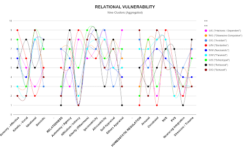
Summary: Relational vulnerability is a continuous epigenetic dimension of interpersonal psychopathology (“disorders of personality”) manifesting in four main endophenotypic clusters based on (i) disordered HOMEOSTATIC REGULATION (High / Low) and (ii) maladaptive RELATEDNESS (High / Low). Currently used categories (diagnoses) of “personality disorders” correspond to one of the four clusters…

Continue reading

Ipsocentricity (2022)

Psychopathology is an epi-ontogenetic disturbance (disorder) of associative integration manifested in impairments (symptoms, signs) of Homeostatic Regulation (activation, emotionality, neurocognitive integration) and Interpersonal Relatedness (Self-Others, intersubjectivity). Homeostatic dysregulations are associated with the biophysical (biological) aspects of psychopathology and dysregulated Relatedness underlie its interpersonal manifestations. Ipsocentricity (focus on oneself) is a…

Continue reading

Internal / interpersonal state (I-State) and psychopathology

Fundamentally, psychopathology is a sequence of events within and across all four registers of an I-STATE.  In time, a unique internal / interpersonal configuration (position, state) develops, aspects of which are perceived (by one and others) as a maladaptive dysregulation (dis-order, impairment) of  a “normal” (typical, expected) or desired way…

Continue reading

UNIQUENESS – patterns of being and representation (relational style, identity, gender) 

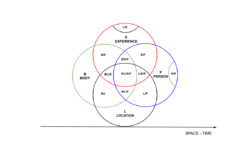
Prototypical configurations of the four registers correspond to unique patterns (styles) of being and experiencing (representing) oneself and others (“identity”, “personality”) . For instance: The six prototypical [Lxxx] configurations (LBEP, LBPE, LEBP, LEPB, LPBE, LPEB) correspond to a style (pattern) focused on location, including (i) tangible proximal events (entities, things)…

Continue reading

UNIQUENESS and Personality Disorders (2020 Model)

‘Disorders of personality”   “Personality” is a neurocognitive aspect of UNIQUENESS. It underlies and regulates unique features of one’s biophysicality, cognitions, emotionality and behavior across multiple contexts and locations. “Personality Disorder” is an epigenetic neurocognitive dysregulation of personality endophenotype manifested in discrete configurations (syndromes) of phenotypic signs and experienced symptoms…

Continue reading

Uniqueness and Psychopathology – Part I

Psychopathology is (i) an expression and (ii) a study of maladaptive dysregulation (dis-order, impairment) of one’s BODY (biophysical functions, appearance, behavior) and EXPERIENCE (sensations, affects, awareness, ideation), in a PERSON among others, across multiple LOCATIONs.  It is (i) subjectively experienced and represented in one’s consciousness as symptoms; (ii) observed and…

Continue reading