Fundamentally, psychopathology is a sequence of events within and across all four registers of an I-STATE.
In time, a unique internal / interpersonal configuration (position, state) develops, aspects of which are perceived (by one and others) as a maladaptive dysregulation (dis-order, impairment) of a “normal” (typical, expected) or desired way of being causing a concern (distress, suffering).
Perception of an aspect of the I-STATE as maladaptive (“disorder”), healthy (“normal”, typical) or optimal (“desirable”) is predicated on the perspectival vantage point and context of the observer (subjective, interpersonal, academic) and may vary substantially in focus, complexity and coherence for different aspects of psychopathology.
Problematic aspects of the I-STATE may be experienced by one as distressing symptoms (experiences) and by others as distressing signs (markers). Signs may be outside of one’s consciousness and symptoms may be unobservable (private). Expressed symptoms become observable signs.
Each region of the I-STATE makes a distinct contribution to the formation of symptoms and signs of psychopathology.
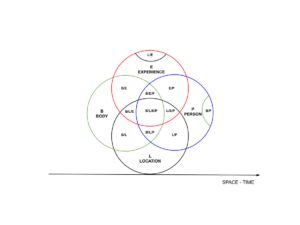
Formation of symptoms – regions E, B/E, L/E, B/L/E.
Region E represents maladaptive events (symptoms) in one’s consciousness (.e.g. suicidal ideation, delusions, intrusive thoughts / urges, flight of ideas, racing thoughts, negative self-image, aberrant beliefs, difficulty concentrating, diminished ability to think or concentrate, distractibility of attention, depersonalization).
Region B/E represents a wide range of symptoms at the interface of one’s body and consciousness (e.g. anxiety, fears, worry, mood swings, depression, psychosomatic preoccupations, anhedonia, emotional problems / dysregulation, ego-dystonic desires / craving).
The L/E region represent maladaptive co-construction of one’s experience and location (sensory / semantic space) (e.g. hallucinations, dissociation, derealization, paranoid / referential ideation / beliefs, idiosyncratic focus / preoccupation, confusion)
The B/L/E region represents problems (symptoms) arising at the interface of one’s (i) body, (ii) spatiotemporal location (sensory and semiotic space) and (iii) experience. They are location-specific, private and typically unknown to others (e.g. seasonal changes, insomnia, phobias, fears, problems with sexuality or gender identity, body image, fetishes, rituals, urges, cravings, somatization).
Formation of signs – regions B/P, B/L/P.
Region B/P represents aspects of one’s body (biophysicality, behavior, appearance) perceived by others as markers (signs) of psychopathology.
They may include observable, non-conscious, maladaptive events (signs) arising at the interface of one’s body and societal / interpersonal position (e.g. posture, body language, submission, dominance, alpha-behaviors, gendered behaviors, age-related). One enacts / embodies one’s societal / interpersonal position in a way that others experience and mark as distressing (odd, atypical, exaggerated, dysregulated, frightening). As a result, both the body and the markers change accordingly in an interpersonally maladaptive way.
It is about how one’s body functions (as a representation) in the minds of others and the reciprocal effect of that representation (markers) on one’s body itself.
Region B/L/P represents aspects of one’s body (biophysicality, behavior, appearance), at a particular location, perceived by others as markers of psychopathology (e.g. inappropriate, distressing). They (i) have a known biophysical or behavioral component, (ii) are observable to others, (iii) are embedded within a particular location, (iv) are outside of one’s awareness (e.g. psychomotor agitation / retardation, (lack of) insight / judgement, neurodevelopmental / neurocognitive deficits) or reflect non-conscious qualities (traits) (e.g. appearance, absent-mindedness, eccentricity, intensity), They often coexist with symptoms associated with region E described above.
Symptoms and signs – regions E/P, B/E/P, L/E/P and B/L/E/P
The E/P region represents relational (intersubjective) experiences and markers that are distressing to both one and others (e.g. trust, attraction, love / aversion, hate, alienation / affiliation). One and others reflect (mirror) their reciprocal experiences and markers via projective perception (identification) (e.g. A experiences (marks) B as “X” (interesting, boring), B knows it and A is aware that B knows). Region E/P represents the relational function of experience and societal / interpersonal markers (intersubjectivity) that are concerning (distressing) to both one and others (signs and symptoms).
The B/E/P represents (i) problems (symptoms, signs) defined by their incongruency with one’s location (e.g. disorientation, amnesia, flashbacks, dislocation / travel, violation of norms or others’ space / privacy) and (ii) any distressing experience (B/E) observable by others (P) (e.g. depression, anxiety, anger)
The L/E/P region reflects the construction of idiosyncratic (maladaptive) representation of the sensory / semiotic “reality” of one’s location (object relations) (e.g. delusions, unusual perception, sensations, ideation, beliefs) and its reciprocal phenomenological and intersubjective manifestations (e.g. alienation / idealization / devaluation / identification, externalization / internalization / projection) that are distressing to both one and others.
Finally, the B/L/E/P region represents distressing events (deficits, symptoms, signs) that (i) have a distinct and known biophysical and/or behavioral component, (ii) are conscious as a particular experience, (iii) are observable and perceived (marked) by others (iv) are embedded within a particular spatiotemporal location. They are present in most manifestations of psychopathology as distinct dysregulation of biophysicality, emotionality, cognition and interpersonal behavior across multiple locations. (e.g. impulsivity, avoidance, inhibitions, disorientation, violence, aberrancy)
Contributing events (causative, moderating) – regions B, L, P, B/L, L/P
Region B represents all biophysical (epigenetic, metabolic, homeostatic) events (variables) underlying structural and functional dysregulation of the body (e.g. nervous / digestive / immune / cardiovascular / skeletomuscular systems, molecules, circuits, physiology, neurotransmitters, hormones, etc.) It may also include private (unobservable) behavior / appearance outside of one’s awareness (non-conscious) (e.g. mannerisms, facial expressions, gestures / movements) associated with one’s way of being in private.
Region L reflects a dysregulation (disturbance) within one’s spatiotemporal sensory and semiotic space (e.g. trauma, stressors, triggers).
Region P represents societal markers (SEC status, stories, expectations, memories, reputation) which may contribute to one’s psychopathology (e.g.stereotypes, misrepresentations, rumors, mistaken identity, celebrity, fame, prejudice, stigma).
Region B/L represents contributing events associated with the interface (position) of one’s body and spatiotemporal location (sensory and semiotic space, gravity) (e.g. seasonal / diurnal changes, arousal, reactivity, activity)
The L/P region represents markers of one’s spatiotemporal / societal position (e.g. place of birth, address, neighborhood, geographical region, nationality) which may contribute to the formation of psychopathology (e.g. self-image / self-schema, identity, beliefs, expectations, stereotypes, bias)