In the society, one’s being is viewed from at least three perspectives: (i) subjective – how one experiences and represents oneself; (ii) interpersonal – how one is represented in the experience of others and (iii) public – how one is represented in and marked by the official public records, including the (academic) discourse of science. While one’s representation of oneself reflects all four registers of UNIQUENESS, the representations by others and by the public / scientific markers reflect one’s LOCATION, BODY (appearance, behavior) and PERSON.
Policy and the law
In public policy and the law one exists and is identified as a specific BODY (biophysical mass, DNA, appearance, behavior ) at a specific LOCATION associated with a unique spatiotemporal continuity of societal markers (name, government identification code, place / date of birth, parents, addresses, activities and, roles, functions). One is considered to be the same unique individual across one’s entire life span, irrespective of all changes and is always the “same” PERSON associated with the “same” BODY even if their particular attributes (markers, appearance, behavior) change across the trajectory of spatiotemporal LOCATIONs. One is always the “same” PERSON and BODY from birth to death even if the LOCATION, EXPERIENCE and the actual biophysicality of one’s body are not.
Legally, one can be held accountable for one’s behavior irrespective of the passage of time and subsequent changes in one’s life (e.g. war crimes, felonies without a statute of limitations). The legal accountability is based on the spatiotemporal continuity (identity) of the PERSON and the BODY but not necessarily of one’s EXPERIENCE. However, is one, many decades and life changes later, still the same individual?
Similarly, one can be paroled (as reformed / rehabilitated) based on the changes in one’s (now “good”) BEHAVIOR and inferred changes in one’s EXPERIENCE. However, forgiveness notwithstanding, is the parolee a different individual?
The question of continuity of identity, agency and accountability (same-ness) across the four registers lies at the core of societal challenges presented by individual uniqueness.
Why are the death penalty allowed (legal) but suicide is not? Death is an end of one’s BODY’s life and one’s ability to EXPERIENCE but almost never an end of the PERSON or LOCATION. In fact, one can continue endlessly as a PERSON associated with a particular trajectory of LOCATIONs (history). The society usurps the authority to allow or to make one to end the life of the BODY and EXPERIENCE of others but not one’s own. A prison executioner is authorized to end the life of a death row inmate but not his own.
Is it possible to reverse it and to give the society the power to put an end to the PERSON without ending the life of one’s BODY and EXPERIENCE? A life sentence without parole in solitary confinement at a maximum security facility comes as close as legally possible. Suicide is a desire to end one’s life as one experiences and knows it. Can one’s life be ended not by biophysical termination of the corporeal BODY and EXPERIENCE but by termination of the societal PERSON and its markers? Instead of self-destruction of the BODY could one “self-disappear” as a PERSON but remain biophysically alive? All interpersonal and societal steps and records of such “suicide” would be irreversibly enacted, permanent and legally enforced ad infinitum (execution of one’s Will, inheritance, mourning, “funeral”, “grave” (“place of departure”), etc.). A designated facility, staffed by a new breed of specialized “PERSON-al transformation teams” would be set up where individuals could stay until they are ready to return to the mainstream life as a new PERSON and, more importantly, embodying (embo-dying) a new (non-suicidal) EXPERIENCE.
As strange as such process may appear to us at this time, might it be an alternative to actual suicide or euthanasia and, perhaps, substantially reduce costs of mental health care and, likely, mass incarceration?
Similar concerns arise with respect to the beginnings of individual life and revolve around the questions about when a fetus becomes a PERSON. Is a fetus a part of the mother’s body or an experiencing, embodied PERSON within (inside) of the mother’s BODY? Does the PERSON originate at conception, at birth or somewhere “in between”?
Some mothers speak about experiencing an in utero fetus as an emerging biophysical presence (BODY) of an “Other” outside of the familiar boundaries of their own “I”, agency and movement in particular. Some others are focused more on LOCATION – in utero vs postpartum as meaningful. However, the question of separateness is different from the question of uniqueness.
From the UNIQUENESS perspective, the question is how it is determined when a newly conceived life (embryo) becomes a unique BODY, unique LOCATION, a unique EXPERIENCE and a unique PERSON? And perhaps most importantly, who makes that decision and how?
Culture wars
Once born, an individual is immediately presented with challenges of societal / cultural tribalism, including, among many, language, ethnicity and race.
In general, tribalism, (ethnic, racial, other) arises when perceived differences in the four registers of UNIQUENESS (BODY, PERSON, EXPERIENCE, LOCATION) override their actual commonalities.
There is tribalism (i) of the LOCATION (continents, countries, regions, localities, neighborhood, address), (ii) of the BODY (race, gender, age, size, appearance), (iii) of EXPERIENCE (sensations, awareness, ideation) and (iv) of the PERSON (societal markers, culture, language, laws).
Ethnicity, as a societal and cultural attribute of UNIQUENESS, is associated primarily with the BODY (DNA) and LOCATION (country of origin) and, secondarily, with the PERSON (ethnic subculture) and EXPERIENCE (consciousness) (BLPE).
Race is primarily an attribute of the BODY (skin color, DNA, appearance) and secondarily of the PERSON (societal markers of race) and EXPERIENCE (experienced identity) (BPEL) (see Graph below)

Tribalism involves multiple and overlapping registers, domains and aspects of life. Tribalism of the BODY may pertain to race (e.g. white supremacists, segregationists), gender (e.g.misogyny), appearance (e.g fashion, fitness, body build), age or a physical disability. Tribalism of the PERSON may refer to societal markers of status (e.g. meritocracy of education, wealth), political spectrum (Left vs Right), religion (e.g. Hindu vs Muslims, Catholics vs Protestants), club or gang membership, etc. Tribalism of LOCATION may involve entire countries (e.g. Israel and Iran), geography (e.g. South vs North, coast vs inland); populations (urban vs rural), local neighborhoods or micro-locations within a particular area (e.g. office space, apartment, subgrouping at an event). Tribalism of EXPERIENCE can be based on shared values (e.g.conservative vs progressive), interests (e.g. art vs business) or more broadly, on the focus of one’s consciousness on a particular register or domain of life (work, public, community, intimate, private)
Tribalism, including ethnicity and race, as a dialectic between representation of oneself and representation of others, is experienced and manifested differently by different individuals and groups (stereotypes) and changes in (i) focus (BODY, LOCATION, EXPERIENCE, PERSON) and (ii) relevance (intensity, valence, regard) across individuals, groups and main domains of life (see two Graphs below)
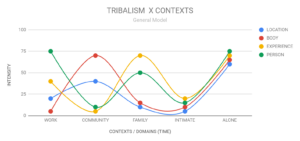
Graph T-C-GM – Tribalism and Contexts – General Model
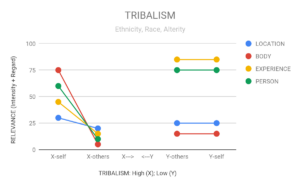
Graph T-C-ERA – Tribalism – Ethnicity, Race, Alterity
Contemporary geopolitical and socioeconomic tensions, including the divergence between forces of globalization and the national / cultural / local identities, seem to revolve around control over land or territory (LOCATION), ethnicity, race, appearance and behavior (BODY), religion, culture, nationality, history, SEC status (PERSON) or shared desires, values, lifestyle choices and preferences (EXPERIENCE).
Language and speech, and their local attributes (syntax, semantics, lexicon, accent, dialect, jargon, etc.), have evolved to be inherently tribal – they represent both the within-group commonalities and between-group differences.
As long as we speak and think in different languages and inhabit separate and demarcated parts of the globe governed by autonomous nations, the strife between one vs fragmented Earth is likely to continue.
Politics, social media, marketing and behavioral economics
Contemporary societies are regulated by the Desire to be or to have something or someone. What exactly “to be” or “to have” mean is often poorly understood or articulated.
Votes, “clicks”, “likes”, “followers” and wealth and celebrity quantify desirability and status. Competition for the attention of others (publicity, fame, media, business) is the “new normal” paradigm of public discourse.
Politics, at least in a democracy, are about winning votes and elections. It is a game of the dialectic of DESIRE, played publicly by elected officials and the voters.
Politicians engage in performative behaviors (BODY) choreographed to influence the EXPERIENCE and, ultimately, the voting behavior (BODY) of others. They typically focus on voters’ LOCATION (e.g. city, county, state, region), BODY (e.g. age, gender, race), PERSON (ethnicity, religion, status, life style) or EXPERIENCE (e.g. feelings, interests, values, preferences).
Reciprocally, the voters engage in constructing a representation of the politicians in their EXPERIENCE (consciousness). The voters representations also focus on the LOCATION (e.g. state, region, city, neighborhood), BODY (race, gender, age), PERSON (education, status, ethnicity, religion) or EXPERIENCE (ideation, feelings, sensations) associated with each politician. A political win is a successful match and a collective compromise among all involved parties.
Social media allows one to establish an online presence (re-presentation) to express (communicate) something to others. It is a performative behavior within the register of the BODY which both reveals and conceals one’s actual corporeal body and its behavior. One may choose to present (post, tweet, share, etc.) focusing on LOCATION, BODY (appearance, behavior, activity), EXPERIENCE (thoughts, feelings, concerns, values, desires) or PERSON (publically / interpersonally marked events, records or products).
Unlike most in-person behaviors at one specific location, the online ones create a permanent digital record which can be then accessed and experienced by others at an infinite number of other locations. Sometimes a digital record of one’s “private” behavior online is made public, or an already public record receives increased attention or scrutiny, often resulting in unintended consequences for all involved. More broadly, online social media allow one’s LOCATION, BODY, EXPERIENCE and the PERSON to be “shared” with and by others, including virtual reality, avatars and online gaming,with implications addressed further in Chapter 4 below.
Individual UNIQUENESS is particularly relevant in behavioral economics and marketing. Understanding how each of the four registers contributes to human economic behaviors, buy / sell market decisions and consumer purchasing choices is key in any industrial society. How does one’s cognitions and feelings (EXPERIENCE) affect one’s economic behaviors (BODY). How do LOCATION (in-store vs online, mall vs local vendor, geographical context, urban vs rural), BODY (biophysical states, gender, age, appearance / behavior / speech), EXPERIENCE (sensations, feelings, thoughts, desires, fantasies) and the PERSON (language, religion, SEC markers) of the “seller” and the “buyer” affect the flow of economic and business transactions?
Patterns of and preferences for particular economic behaviors (decisions, choices) of both “sellers” and the “buyers” correspond to and are predicated on the interpersonal / personality styles described above (Bxxx; Lxxx, Exxx, Pxxx) and can be used to optimize business / market transactions.
In many cases, one’s political, social media and business presence are intricately intertwined and mutually leveraged to maximize political gain, social media exposure and financial profit (e.g. Trump presidency). Both issues will be explored further in Chapter 4 below.
Mental health
Substance addictions, addictive behaviors, interpersonal / personality problems, suicide, trauma, violence, crime are widely prevalent and pervasive in postmodern societies. They, as most psychopathology in general, occur at a particular context or circumstance (LOCATION), involve specific (maladaptive) biophysical processes and overt behaviors (BODY), follow sequences of recurrent internal states (EXPERIENCE) and have interpersonal / societal effects registered (marked) by others (PERSON).
Although all four registers are always involved in symptom formation, some symptoms may be primarily associated with LOCATION (PTSD, specific phobias, anxiety), with the BODY (anorexia, addictions, mania, compulsions, behavioral / conduct / impulse control problems), with EXPERIENCE (psychosis, dissociations, obsessions, delirium, dementia) or with the PERSON (violation of societal / interpersonal norms and / or expectations). Many mental health problems involve complex interactions across all four registers (personality / gender / sexuality related problems).
Normative considerations regarding the definition and demarcation of “normal” vs “abnormal” and an ongoing societal, cultural and scientific debate about how to conceptualize, identify (diagnose) and prevent mental illness have been underway for a century in modern societies.
The role of UNIQUENESS in psychopathology, interpersonal (personality, Self, identity) disorders and their treatment in particular, are explored in depth in Chapters 2 and 3 below. A broader discussion of UNIQUENESS, mental dis-ease (symptoms), Buddhist psychology and philosophy of suffering (“dukkha”) is addressed in a separate post.