Summary:
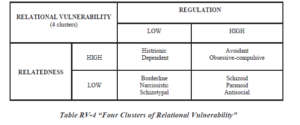
Relational vulnerability is a continuous epigenetic dimension of interpersonal psychopathology (“disorders of personality”) manifesting in four main endophenotypic clusters based on (i) disordered HOMEOSTATIC REGULATION (High / Low) and (ii) maladaptive RELATEDNESS (High / Low). Currently used categories (diagnoses) of “personality disorders” correspond to one of the four clusters (See Table RV-4 below)
|
RELATIONAL VULNERABILITY (4 clusters) |
REGULATION |
||
|
LOW |
HIGH |
||
|
RELATEDNESS |
HIGH |
Histrionic Dependent
|
Avoidant Obsessive-compulsive |
|
LOW |
Borderline Narcissistic Schizotypal |
Schizoid Paranoid Antisocial |
|
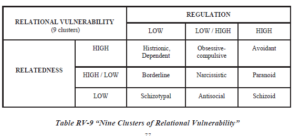
To account for variability and changes in High / Low RELATEDNESS and High / Low REGULATION, a more nuanced distribution involves nine clusters (see Table RV-9 below)
|
RELATIONAL VULNERABILITY (9 clusters) |
REGULATION |
|||
|
LOW |
LOW / HIGH |
HIGH |
||
|
RELATEDNESS |
HIGH |
Histrionic, Dependent |
Obsessive-compulsive |
Avoidant |
|
HIGH / LOW |
Borderline |
Narcissistic |
Paranoid |
|
|
LOW |
Schizotypal |
Antisocial |
Schizoid |
|
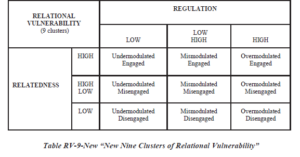
To increase conceptual, terminological and clinical clarity of categorization, new labels for the nine clusters (types) of RELATIONAL VULNERABILITY (“Disorders of Personality”) are introduced and presented in the Table RV-9-NEW below.
|
RELATIONAL VULNERABILITY (9 clusters) |
REGULATION |
|||
|
LOW |
LOW / HIGH |
HIGH |
||
|
RELATEDNESS |
HIGH |
Undermodulated / Engaged |
Mismodulated / Engaged |
Overmodulated / Engaged |
|
HIGH / LOW |
Undermodulated / Misengaged |
Mismodulated / Misengaged |
Overmodulated/ Misengaged |
|
|
LOW |
Undermodulated / Disengaged |
Mismodulated / Disengaged |
Overmodulated / Disengaged |
|
DESCRIPTIONS OF CLUSTERS
Cluster U/E (“Histrionic” / “Dependent” spectrum).
Undermodulated / Engaged (Low Homeostatic Regulation; High Relatedness)
Individuals in the U/E cluster experience themselves (I / Self) as a flow of sensations and feelings rather than as ideation (concepts, ideas). They desire and value affiliation, intimacy and love and tend to avoid autonomy / agency. They are reactive and impulsive and often overwhelmed by negative (aversive) i-states and affects when alone and / or by the positive (pleasurable) ones when in close contact with the desired others. They often dissociate and are cognitively dysregulated, particularly in reaction to interpersonal, attachment and experiential stressors (abandonment, rejection, indifference) and function in a chronic and self-perpetuating negative feedback loop between their low neurocognitive integration and elevated exposure to stressors. Individuals in the U/E cluster are typically perceived as attractive and unusual (alterity) and their unmodulated and hyper engaged style may easily overwhelm relational availability of others.
Cluster U/M (“Borderline” spectrum)
Undermodulated / Misengaged (Low Homeostatic Regulation; Low-High Relatedness)
Individuals in the U/M cluster experience themselves (I / Self) as a flow of intense and volatile sensations and feelings which easily overwhelm capacity for ideation (mentalization). They crave intimacy and love and often pursue relationships wilfully (agency) in a violation of their own and others’ boundaries (autonomy). They are reactive and impulsive and easily overwhelmed by extreme negative (aversive) i-states and affects (anger, anxiety, disgust) when alone or separated from / rejected by desired / loved others. They are vulnerable to affect-driven dissociations and cognitive dysregulation, particularly in reaction to perceived interpersonal, attachment and experiential stressors (abandonment, rejection) resulting in a volatile and self-perpetuating negative feedback loop between their low neurocognitive integration and elevated exposure to multiple stressors. Individuals in the U/E cluster are typically perceived as intense, chaotic and often strange (alterity) and their unmodulated and volatile style is often experienced as aversive resulting in interpersonal rejection and avoidance by others.
Cluster U/D (“Schizotypal” spectrum)
Undermodulated / Disengaged (Low Homeostatic Regulation; Low Relatedness)
Individuals in the U/M cluster experience themselves (I / Self) as a flow of idiosyncratic thoughts and sensations which are not shared with and by others. They protect their relational vulnerability (psychoticism) by distancing, independence and individuality (autonomy / agency) resulting in excessive preoccupation with own internal world (ipsocentricity) at the cost of participation in the shared, consensual reality. They are very reactive (arousal) but not impulsive (constraint), experience multiple aversive (NVS) i-states and can become associatively (internally) dysregulated (quasi psychotic) in response to sensory, ideational overstimulation and relational / biophysical / experiential stressors. Individuals in the U/E cluster are typically perceived as odd (alterity), creative even if difficult to understand, and their unmodulated idiosyncratic experiences and self-protective disengagement often results in interpersonal isolation and estrangement from others.
Cluster M/E (“Obsessive-Compulsive” spectrum)
Mismodulated / Engaged (Low-High Homeostatic Regulation; High Relatedness)
Individuals in the M/E cluster experience themselves (I / Self) as a flow of (unstoppable, recurrent) thoughts and ideas. They are self-righteous and strive to impose their ideas on others which often results in interpersonal strife (stressors). They are very reactive, driven by intense, mainly aversive i-states (anger, shame, anxiety, fear) and fluctuate between rigid self-control (constraint) and explosive discharges of pent-up negative emotions. They have very limited capacity for positive i-states (PVS) which they view as trivial or indulgent, affection / intimacy in particular. Individuals in the M/E cluster are typically perceived as driven, controlling / rigid, excessively focused on work and productivity which, combined with their intermittent emotional outbursts often leads to interpersonal conflicts and alienation.
Cluster M/M (“Narcissistic” spectrum)
Mismodulated / Misengaged (Low-High Homeostatic Regulation; Low-High Relatedness)
Individuals in the M/E cluster experience themselves as a flow of thoughts and ideas and place the I / Self at the center of their consciousness, either in an idealized (grandiose, “I am better than others”) or devalued (defeated, “I am worse than others”) position. Others are typically devalued and disregarded or idealized if needed or desired (part / self-objects). Internal / interpersonal states, including emotions and behaviors maintain and perpetuate the preferred idealized (prideful self-admiration) or devalued (shame, disgust) perspectival / relational position. Either way, they believe they deserve or require to be treated preferentially and react with aggression and anger when it is challenged or not accommodated. Being “like others” is a threat to the I / Self as it violates the lifelong experience of oneself as “different” (“special”). They have limited capacity for intimacy and empathy and are perceived as self-centered (self-absorbed), inconsiderate or adversarial which often leads to interpersonal conflicts and alienation from others and perpetuates their chronic sense of being misunderstood, mistreated and “different”.
Cluster M/D (“Antisocial” / “Psychopathic” spectrum)
Mismodulated / Disengaged (Low-High Homeostatic Regulation; Low Relatedness)
Individuals in the M/D cluster experience themselves as corporeal movement and vocalization (speech), tangible (utilitarian, spatiotemporal) and / or communicative (performative, semantic). The I / Self are at the center of their consciousness, construed as action employed primarily to effect (control) events and relations. They strive to be independent (autonomy), controlling (agency) and have very limited capacity for empathy, intimacy and attachment (affiliation), others are disregarded, devalued and instrumentally exploited in the pursuit of goals and interests.They are typically unemotional but can become enraged and behaviorally explosive when frustrated or thwarted. They fluctuate between conflicting positive and negative i-states and their poorly integrated cognitions and behaviors often violate societal norms and interpersonal expectations resulting in multiple l biophysical and legal stressors and trauma (injuries, crime, incarceration). Individuals in the M/D cluster are perceived by others as inconsiderate, exploitative, aggressive or dangerous resulting in interpersonal rejection, alienation, violence and crime which further perpetuates the impossibility and failure of mutual relationality and their self-centered, action-based, dysregulated and disaffiliative (disassociated) position.
Cluster O/E (“Avoidant” spectrum)
Overmodulated / Engaged (High Homeostatic Regulation; High Relatedness)
Individuals in the O/E cluster experience themselves ( I / Self) as a flow of thoughts and feelings. They place themselves and their standing (position) among others at the center of their consciousness. They tend to undervalue themselves and desire affiliation and intimacy with idealized others who are desired and feared at the same time. They are reluctant to initiate contact and engage with others in order to shelter themselves from typical relational interpersonal challenges (conflict, competition, rejection). Intense i-states (desires, fears) are private, controlled and predominantly negative (anxiety, worry) at the cost of the positive ones (pleasure). Individuals in the O/E cluster are perceived by others as reluctant to engage, shy, aloof or strange which further exacerbates their relational isolation and interpersonal fears and anxiety.
Cluster O/M (“Paranoid” spectrum)
Overmodulated / Misengaged (High Homeostatic Regulation; Low-High Relatedness)
Individuals in the O/M cluster experience themselves ( I / Self) as a flow of intensely focused thoughts and expressive / communicative behaviors revolving around protecting their standing (position) among others which is the main focus of their consciousness. They either devalue or idealize themselves and tend to demonize others who are feared as imaginary competitors, threats or oppressors. Interpersonal vigilance, separateness (disassociation) and counterdependence are in conflict with the desire for love and intimacy and serve to preempt any real or fictional challenges or dangers associated with the presence of others. I-states are very intense (desires, fears, anger), volatile (explosive) but well controlled, predominantly negative (aggressive, hostile) at the cost of the positive ones (pleasure, affiliation) and can derail towards neurocognitive dysregulation (psychoticism). Individuals in the O/M cluster are perceived by others as antagonistic, belligerent and aversive which exacerbates their relational alienation, fears and enmity and further perpetuates interpersonal strife (stressors)
Cluster O/D (“Schizoid” spectrum )
Overmodulated / Disengaged (High Homeostatic Regulation; Low Relatedness)
Individuals in the O/D cluster experience themselves ( I / Self) as a flow of abstract thoughts and ideas. They are focused on and value themselves, are preoccupied with concepts (ideas) and imagination, and like to be left alone. Self-determination, independence and intellectual pursuits are preferred over emotional or physical contact, affiliation and intimacy with others. They are typically taciturn, constrained and often dissociated (split-off) from desires and affects. Low intensity i-states are mainly ideational with minimal biophysical, behavioral or interpersonal participation. Individuals in the O/D cluster are perceived by others as aloof, cold, self-absorbed and odd which perpetuates mutual disassociation and relationally distancing.
Download full PDF with all tables and graphs