We are threatened with suffering from three directions:
from our own body, which is doomed to decay and dissolution
and which cannot even do without pain and anxiety as warning signals;
from the external world, which may rage against us with overwhelming and merciless forces of destruction;
and finally from our relations to other men.
(Sigmund Freud)[1]
Uniqueness is a fundamental constitutive attribute of being, being human and human individuality. It exists and functions within and as the four REGISTERS of (i) one’s BODY (biophysicality, appearance, behavior); (ii) one’s LOCATION (sensory / semiotic space); (iii) one’s CONSCIOUSNESS (attention, awareness, ideation) and (iv) as a PERSON (societal / interpersonal markers, records, products) among others. Psychopathology, an expression (and a study) of psychological dis-order (impairment, illness), is an aspect of uniqueness associated with dysfunction, dysregulation and / or suffering / distress.
Both uniqueness and psychopathology are conceptualized as an internal / interpersonal state (I-STATE)[3] – what and how one is (becomes) in space and time – mutually reflected (re-presented and affected) within and by the four REGISTERS. Topographically, I-STATE is now visualized as a three-dimensional space, a B-L-C-P tetrahedron, defined by the four REGISTERS and encompassing fifteen REGIONS (four (4) vertices, four (4) faces, six (6) edges and one (1) internal space) (see Graphs RRP – BLCP below).
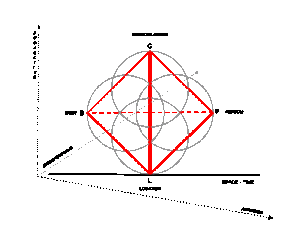
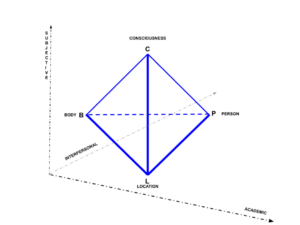
Graphs RRP – BLCP Tetrahedron – Registers X Regions X Perspectives
The new B-L-C-P tetrahedron replaced the previous visual representations (modified Venn diagram and the truncated tetrahedron) (see graphs RRP-2021, TT-2021 below).
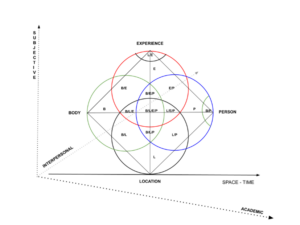
Graph RRP-2021 – Registers X Regions X Perspectives
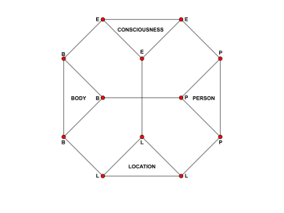
Graph TT-2021 – I-STATE (Truncated Tetrahedron)
Experience and consciousness
The term CONSCIOUSNESS refers to the process (activity) whereby selected aspects of the physical world (EVENTS, RELATIONS), upon contact with the human nervous system, are transformed (translated) into sensations (perception), neurocognitive representations (awareness) and ideation (thoughts, images, interpretation, meaning). The term “experiencing” is now used to refer to events directly at the intersection of the BODY and CONSCIOUSNESS (e.g. sensations, feelings). EXPERIENCE is how one’s body and consciousness interact with each other.
Human consciousness is an evolutionary phenomenon at the interface of the spatiotemporal physical world, biological life (nervous system) and civilization (culture, language, signs, science, technology) mutually reflecting (re-flect, re-present + affect) each other[4]. As a natural function of the physical world in general, life and civilization in particular, human consciousness exists and functions as and in space-time and has evolved along with the capacity to form, store and process progressively more complex neurocognitive representations (memory, ideation, language, learning) of material reality and to regulate associated spatiotemporal behavior, in the service of collective and individual adaptation and survival.
The “function” aspect of CONSCIOUSNESS is distinguished from its “structure” and “content”.
The “function” (process, activity) refers to the nervous system’s transformation (translation) of the physical world into neurocognitive representations, ideation and meaning and the regulation (activation, control) of behavior and action. The functional aspects of human consciousness unfold as-and-in time and are typically localized within one’s body and individually unique.
The “structure” (texture, fabric) of consciousness refers to the elemental sensory, representational and ideational components (building blocks) of human consciousness corresponding to (reflecting) (i) the physical properties of the material world; (ii) the survival aspects of nature (life) and (iii) the adaptation aspects of civilizations it is a part of (language, culture). Sensory components may include basic sensations (mass, shape, color, position, temperature, time). Representational components include basic representations (events, relations, objects). Ideational components include basic thoughts and images (concepts, ideas) involved in the interpretation and formation of meaning. The structural aspects of human consciousness are co-localized (exist) both within and outside of one’s body.
The “content” of consciousness (reality) – the world, life, civilization and culture (products, signs, symbols, language) – is widely distributed beyond any singular “body”. A unique, individual, representation of an event / relation / entity (object, idea) as ideation, (thought, image) in a singular mind and brain is only possible because the very object or idea already exists in the reality collectively maintained by and shared as products and representations in multiple minds and brains of others[5]. New representations, ideas, images and products are constantly generated and added using the already existing and shared ones.
Registers and Regions
Each individual human life is a unique I-STATE which emerges generations prior to one’s conception and birth (as LOCATION and PERSON) and often continues endlessly (as PERSON). Each I-STATE consists of 15 REGIONS manifesting different aspects of one’s uniqueness (being, life).
Although all 15 regions are always present in each i-state to a different degree which can approach insignificance, they are described below as “separate” entities to elucidate the distinct contribution (role, function) of each of them
Updated formulation of the 15 REGIONS is below (see Graph R below)[6].

Graph R – Regions (Aspects) of Uniqueness (I-State)
Mutuality – region B/L/C/P
The B/L/C/P (B=L=C=P) region encompasses full i-states in which the BODY, LOCATION, CONSCIOUSNESS and the PERSON (B=L=C=P) are re-flecting (re-presenting + re-acting to) each other in a co-construction of a moment of reality (EVENT). Aspects of one’s body (biophysicality, behavior, appearance), location (semiotic / semantic space), consciousness (attention, awareness, ideation) and interpersonal / societal markers that become fully congruent in the present moment of the here and now. It is the oneness, immediacy, unity and shared intentionality (Desire) of all four registers of one’s UNIQUENESS manifesting as one EVENT. One and other(s) are fully mutually engaged in the here and now, in a shared activity (action). One’s body, behavior, experience and consciousness are fully attuned and congruent with others and a particular location.
The B/L/C/P region is associated with togetherness, interdependent co-construction of reality, intersubjectivity, relatedness, bonding, attachment, intimacy, “teamness”, identity, “peak performance (the “zone”) and coherence / integration of one’s action among others. It is oneness with and among others, bodies and minds harmonized and reflecting one another.
Mutual / integrated (B=L=C=P) i-states may range from social / public events (natural disaster, emergency, rally, riot, party, teamwork, team sports) to dyadic interactions (care, intimacy, sex, fight, conversation, brainstorming) and can be deemed healthy (adaptation, actualization, realization) or pathological (dysregulation, disorder, impairment) based on the subjective, interpersonal or academic point of view.
Any interpersonal activity (act, transaction) can manifest mutuality if the BODY, LOCATION, CONSCIOUSNESS and PERSON are a fully congruent (integrated, cohesive) event.
Corporeality – region B/L/P
(corporeality-(of)-markers)
B=L=P (B/L/P||C) represents partial, tri-modal, i-states in which one’s body, location and interpersonal markers are fully congruent with each other but outside of one’s consciousness (non-conscious).
All non-conscious aspects of one’s appearance, behavior that are observable and known to others. It is a public BODY and one is unaware of (i) what in one’s appearance and behavior is seen (known) and (ii) how it is perceived (experienced, represented) by others. Outside of one’s consciousness (i) the body is defined (constructed) by (is) its location and its interpersonal / societal markers; (ii) location is defined (constructed) by (is) the body and the (local) markers and (iii) markers are defined (constructed) by (are) the appearance and behavior of the body and the location (the BLP face of the BLCP tetrahedron above)
Examples of the B/L/P||C i-states include any public appearance (observations / perceptions by others outside of one’s awareness), public sections of one’s body inaccessible to one’s senses (facial expressions, the back), body language (as perceived by others), automatic / habitual (non-conscious) action (behavior) sleeping (in the presence of other(s), passing out, biophysical / behavioral signs (ticks, mannerisms), medical procedures (dentist, internal medicine, ophthalmologist, colonoscopy). Corporeality can be deemed healthy or (psycho) pathological based on the interpersonal or academic perspective (expertise) of the observer(s).
Oneness – region B/L/C
The B=L=C (B/L/C||P) region encompasses partial, tri-modal, private (unobserved by or unobservable to others), i-states in which aspects of one’s body (biophysicality, behavior, appearance), location (coordinates, semiotic space) and consciousness (sensations, awareness, ideation) are fully congruent with each other but inaccessible to others (private). One’s unique, private reality, qualia, private BODY absent in (excluded from) one’s societal / interpersonal markers (P) (B/L/C||P). The fundamental uniqueness of one’s body, consciousness and location (“what it is like to be” one in one’s particular body, here and now) never actually accessible to others.
Examples of oneness i-states include most feelings, sensations, somatic psychosomatic experiences, secrets, secret (private) rituals, feelings, preoccupations, desires, fears, thoughts, sensations, fantasies, masturbation, any private time alone. Psychopathology involves any of the above i-states deemed by one to be problematic or distressing.
Translocality – region B/C/P
(translocal connectedness)
The B=C=P (B/C/P||L) region includes partial, tri-modal, i-states in which one’s body (biophysicality, behavior, appearance), consciousness (awareness, ideation) and interpersonal / societal markers are fully congruent with each other, autonomously (independently) of locations (L). The B/C/P i-states can be a part of the present moment of the here and now or may exist only outside of it and involve aspects of interpersonal relatedness that function autonomously of space and time, transcend spatiotemporality (trans-spatiotemporal). It reflects the evolutionary advantage of the human capacity to function independently (autonomously) of the sensory / semantic context of a specific location.
One functions (“exists”, “is”) in more than one location constructed (defined) by one and / or others where the coordinates and sensory / semiotic space are either dis-associated (split) or there are more than one sets of coordinates and sensory / semiotic contexts with corresponding multiple markers (P)
The (B/C/P||L) i-states are predicated on the “meaning “of the LOCATION – (i) how the coordinates of the location are arrived at (defined, constructed) and (ii) how the sensory / semantic space is configured (constructed, defined). Each LOCATION can be configured (constructed, defined, understood) within the (i) subjective, (ii) interpersonal and (iii) academic perspective. The three perspectives can be fully congruent (identical) or autonomous (separate, fragmented). The B/C/P||L i-states appear when the configurations of the LOCATION are not congruent (dis-associated, fragmented, autonomous) within the three perspectives. Examples of the B=C=P: (B/C/P||L) i-states include trans, dissociative states (including intoxications), “flashbacks” and “altered states” of consciousness[7].
Collective consciousness – region L/C/P
The L=C=P (L/C/P||B) region represents partial, tri-modal, i-states in which one’s location, consciousness and interpersonal / societal markers are fully congruent with each other, in a formation (in-formation) of a shared (collective) consciousness of a “reality”, independently of one’s body (biophysicality, behavior, appearance). It is communication (mutual in-formation) and agreement about meaning, mutually understood signs, symbols, and semiotic conventions (culture, knowledge, language, noosphere)[8].
L/C/P reflects an evolution towards cultural capacity for semiotic / symbolic participation (communion), independently (autonomously) of one’s biophysicality (body). The subjective (actual) and the interpersonal (remote, virtual) perspectives on (experience of) one’s body are disassociated (split) and both different from the academic one.
Examples of the (L/C/P||B) i-states include (i) one’s participation in the formation of “consensual reality” (representation, map, semiotic context), academic knowledge (science), politics, social media, public discourse, art; (ii) biophysical anonymity – shared spatiotemporality without direct bodily contact – a trans-embodied semiotic interpersonal communication / contact (exchange of signs, symbols) with others at a shared spatiotemporal event and location (e.g. crowd, rally, performance, community, shared locality); (iii) masquerade – when one’s body (appearance) is trans-formed (modified) to appear different (clothing, tattoo, piercing, surgery, behavioral deception / enactment). Psychopathology of the L/C/P region may include cognitive disorientation, dissociation, psychosis, memory, identity problems, alterity (otherness), alienation.
Body-(of)-location – region B/L
Embodying spatiotemporality.
The B=L (B/L||C||P) region is an autonomous, bi-modal, i-state representing the identity of the body and its location, existing outside of one’s consciousness and experience (markers) of others. The body forms (is) the location, the location forms (is) the body (coordinates, sensory /semiotic). It is always “on” as one’s biophysical presence, position, movement, mass in space and includes biophysical / spatiotemporal, private (non-observable, unobserved) and non-conscious aspects of any i-state. The interface of (i) the effects of location on the body (epigenetics), environmental, biophysical (circadian, diurnal), weather, seasonal, geographical (altitude); (ii) the effects of the body on the location (mass, appearance, products); (iii) automatic (nonconscious) action (movement, behavior). The B/L aspect of i-state is always “on” affecting all other aspects of the four registers.
Examples of B/L i-states include body temperature, metabolism, biophysical processes, internal activation / pace / rhythm, spatiotemporal coordination of private aspects of one’s position, posture, movement, reflexes / habits / tics / mannerisms. Psychopathology of the B/L region may include homeostatic / biophysical dysregulation (hormonal, neurotransmission, metabolic) – jet lag, altitude sickness, new diet, environmental stress (noise, pollution, light, sleep-wake,)
Body-(of)-person – region B/P
Embodying (markers of) others.
B=P (B/P||L||C) is the interface (identity) of one’s biophysicality and its markers, autonomously of the location and consciousness (e.g. age, eye / hair / skin coloration, sex, race, height, weight). It is a nonconscious, public (observable) autonomous, bi-modal i-state which is always “on ” affecting all other facets of the four registers of one’s uniqueness. One embodies one’s own societal / interpersonal markers, the markers are based on and reflect one’s body (appearance, behavior). Can be deemed psychologically healthy (adaptive, functional) or psychopathological (deviant, strange, inappropriate, dysfunctional, maladaptive) based on the subjective vs interpersonal vs academic perspective (point of view). Examples of the B/P i-states include body language (embodied bias / identity), aspects of speech (accent, tone), nonconscious emotions, moods, gestures. Psychopathology of the B/P region may involve appearance or behavior experienced subjectively, interpersonally and / or academically as problematic or distressing to one and / or others. Contributing factors (stressors, SES, stereotypes) (age, eye / hair / skin coloration, sex, race, height, weight) may contribute to a wide range of psychopathology (signs and symptoms) (stress, anxiety, personality, depression, substance use).
Body-(of)-consciousness – region B/C
Embodying[9] consciousness (experiencing oneself).
B=C (B/C||L||P) is an autonomous, bi-modal, i-state in which (i) the body is represented in consciousness and (ii) consciousness is embodied, independently of one’s location and societal / interpersonal markers. It is the body being conscious of (experiencing) itself (consciousness-of-the body). Examples include mood, fatigue, activation / energy level, ipsocentric sensations / feelings (pain, pleasure), psychosomatic processes, bodily reactions, sensations / feelings associated with remembering, (reminiscing), fantasizing, imagining, proprioception / interoception, awareness of / ideation about one’s body. Psychopathology of the B/C region may include any embodiment-of-consciousness perceived subjectively, interpersonally and / or academically as problematic or distressing to one and / or others. Anhedonia, lethargy, activation dysregulation, distorted (devalued, idealized) body image, distressing sensations, distressing ideation about own body (self-harm, suicidal).
Phenomena – region L/C
Perception, sensory awareness.
L=C (L/C||B||P) is an autonomous, bi-modal, i-state at the interface (identity) of events (entities, relations, objects, signs) within a location and one’s perception (consciousness). Semiotic / sensory datum and the dialectics of the semiotic space (horizon) of the location and one’s consciousness (sensations, awareness, ideation) in the formation of a “reality”. Examples of the L/C i-states include properties (shape, color, up / down, left / right); boundaries and distinctions (me / you, here / there, close / far), spatiotemporal orientation and regulation (position, time, place). Psychopathology of the L/C region may involve any phenomenal dysregulation of spatiotemporal orientation (disorientation) deemed subjectively, interpersonally and / or academically as problematic or distressing (delirium, dementia, psychosis, derealization, cognitive confusion).
Ipsocentric mirroring – region C/P
Consciousness of each other’s consciousness. Imagining each other’s subjectivity.
C=P (C/P||B||L) is an autonomous, bi-modal, i-state at the interface (identity) of one’s consciousness and one’s interpersonal / societal markers (representation) in the minds of others, independent of their bodies and locations. Like two mirrors facing and reflecting each other, the only content are the (reflections of) two mirrors themselves. One’s experience is represented (imagined, fantasized) in the consciousness of others and one imagines (fantasizes) that representation in one’s own consciousness. One’s consciousness is centered on the aspects of societal / interpersonal markers of one’s own consciousness (how one is represented in the consciousness of others). It is independent of their bodies and locations (remote, virtual, social media, unobservable) and imagined (fantasized). The mutual congruence of ipsocentric mirroring (imagining) of each other’s subjectivity is predicated on the representational (phenomenal) attunement between one and others. Examples of the C/P region include the following: A is conscious of an i-state, others are aware of it and represent (imagine) A’s consciousness in their minds, A is imagining (fantasizing about) that representation. Does she know what I think? Do they know that I know? She thinks I am inept. What do they think about me? Do they care about what I feel?
Psychopathology of the C/P i-states may involve any aspect of mutual mirroring (imagining each other’s subjectivity), matched (attuned) or incongruent, deemed subjectively, interpersonally and / or academically as problematic or distressing (mutual misrepresentations, stereotyping / profiling, bias, idealization / devaluation / distortion, interpersonal (personality) conflicts, delusions) resulting in dysregulation of relatedness.
Locality – region L/P
Societal / interpersonal signification of one’s location.
L=P (L/P||B||E) is an autonomous, bi-modal, i-state at the interface (identity) of one’s location and its societal / interpersonal markers, autonomous of one’s body and experience. The milieu / context of one’s location – spatiotemporal / interpersonal / societal position (nationality, culture, language, dialect, address). The physical location defines interpersonal / societal position (location =position / status) (office / desk location, address, Zip / Area code, UWS, New York, North America) and their semiotic signification. Examples: Tyler is an American / New Yorker / Asian. Urban / rural; White House / Wall Street / Pentagon, Brooklyn. Psychopathology may involve any aspect of one’s spatiotemporal / societal / interpersonal position (context, milieu) deemed subjectively, interpersonally and / or academically as problematic or distressing.
Biophysicality – region B
B (B=B) is an autonomous, uni-modal facet of i-state encompassing the totality of one’s biophysicality, independent of location (non-positional), consciousness (non-conscious) and societal / interpersonal markers (unobserved). It is always “on” and includes aspects of (i) gene expression; (ii) biophysical processes (iii) metabolism and homeostatic regulation. Examples include epigenetic / temperament aspects of Positive / Negative Valence Systems (Positive / Negative Emotionality), reactivity, impulsivity, metabolism. Psychopathology may involve any epigenetic dysregulation of biophysical functioning
Meta-location – region L
L (L=L) – an autonomous, uni-modal facet of i-state encompassing the totality of signs, symbols, narratives within the location and about the location itself, independently of one’s biophysicality, experience, and one’s societal / interpersonal markers. How a location refers to itself – collective consciousness of others about the location itself. The location in the minds of others (representation). Examples: “good / bad neighborhood (address)”, “Alaska – the last frontier”; “Florida – the sunshine state”; “New York – Big Apple Melting Pot”; “US – a land of opportunity”; “the best / worst place to be”.
Psychopathology – the L region may contribute to the formation of pathogenic (i) experience (sensations, awareness, ideation e.g. identity, self (image / schema), feelings, beliefs); (ii) biophysicality, behavior and appearance (resilience, stress, activation, NVS (pain), PVS (pleasure) and (iii) interpersonal / societal markers (positive / negative bias, stereotyping / profiling, violence vs acceptance)
Meta-consciousness – region C
E (E=E) – an autonomous, uni-modal facet of i-state encompassing the totality of one’s consciousness about (representation of) one’s own consciousness (sensations, awareness, ideation about own sensations, awareness ideation). Consciousness’ capacity to experience itself (i) in the here and now (awareness, OT) and (ii) in the past (remembering), independently of one’s body, location and societal / interpersonal markers. All C i-states are predicated on time and memory, current state can be represented (in the next moment) in one’s sensations, awareness and ideation and past states can be re-represented (recalled, remembered) when neurocognitive memory traces encoded in the nervous system (brain, body) are evoked. Examples include “self-awareness / consciousness”; remembering / reminiscing, ruminations, “lost in thoughts, absent-mindedness”. Psychopathology may include maladaptive (excessive, insufficient, distorted, fragmented) awareness of oneself (“self-absorption” vs. “lack of insight” vs. “psychosis / dissociation)
Meta-markers – Region P
(Markers about markers)
P (P=P) – an autonomous, uni-modal facet of i-state encompassing societal / interpersonal markers (opinions, beliefs) about one’s markers, (memories, records, products) i.e. others’ opinions about one’s markers (name, gender, diagnosis, art, products. memories), independently of one’s body, experience and location. Examples: review / discussion of one’s diagnosis (formulation) / societal presence (social media), status / fame / significance, guilt / innocence (jury verdict). Meta-markers may have pathogenic effects (“stressor”) on one’s body, experience, location.
Incongruent (fragmented) i-states (facets)
The B/L/C/P (B=L=C=P) region (mutuality) is the only one in which all four registered are fully congruent in the here-and-now of the present moment. All other regions involve a degree of fragmentation between the dominant and other, dyadically complementary, i-state(s).
Complementary fragmentation (dyadic) of i-states within the fifteen regions is illustrated by red arrows in the Graph F below.
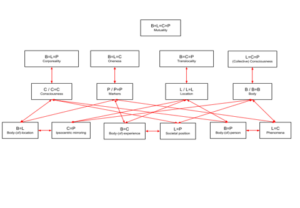
Graph F – Dyadic fragmentation of i-states
[1] Sigmund Freud (1930) Das Unbehagen in Der Kultur (Civilization and Its Discontents, The Standard Edition 1961)
[2] See detailed discussion in Volume I
[3] I-STATE (theoretical construct); i-state (specific, actual internal / interpersonal state; “I”-state (the “I”)
[4] In Buddhism – interdependent origination, karma (Pratītyasamutpāda)
[5] Widely distributed radio / TV / phone waves + an individual receiving device, the internet, social media and crypto currency models are modern technological manifestations (analogs / illustrations) of the dual broadly co-localized nature of consciousness
[6] Each Region is discussed as a separate and distinct entity (an aspect of one’s uniqueness). However, each Region is always a part (subset) of BLCP Region (to a different degree, often approaching insignificance (zero / null values) inside or along the surfaces of the entire B-L-C-P Tetrahedron)
[7] Dis-association of the BODY and LOCATION. One is here but unaware of the location and presence of others. One is elsewhere (the coordinates are the same, semiotic space aspect of the location is split into two or more (L+L). Others are part of the location but now one has no awareness of them. Play, acting, stage, trans, secret observer(s) (P) one is unaware of, (e.g. masturbation / orgasm secretly witnessed by other(s), a child absorbed (lost) in a play, observed by a parent). VR, sleep (dreaming).
[8]Construction of truth / reality truth (reality) (semiotic factuality), Meta-reality. Truth-Facts -” Reality”. Correspondence, conformity. Objectivity as intersubjective agreement. Inter-objectivity / trans-objectivity / transubjectivity / knowledge.
[9] Both as a gerund and a present participle.