‘Disorders of personality”
“Personality” is a neurocognitive aspect of UNIQUENESS. It underlies and regulates unique features of one’s biophysicality, cognitions, emotionality and behavior across multiple contexts and locations.
“Personality Disorder” is an epigenetic neurocognitive dysregulation of personality endophenotype manifested in discrete configurations (syndromes) of phenotypic signs and experienced symptoms (qualia).
More broadly, “disorders of personality” are interpersonal and relational problems (disorders) revolving around relational vulnerability – an epigenetic impairment of associative integration (biophysical, perceptual, neurocognitive, conceptual, affective, behavioral, interpersonal) of relations and relatedness among events and entities within each and among all four registers of UNIQUENESS.
ASSOCIATIVE INTEGRATION is the basic building block (mechanism, function) of self organizing connectedness of life, manifested across all levels of human functioning, and includes molecular, cellular and neural binding, sensorimotor coordination, coherence (unity, cohesion) of attention, awareness, perception, cognition, consciousness and behavior, homeostatic equilibrium, associative memory and learning, intelligence, executive functions, language, interpersonal relatedness, intersubjectivity and societal transactions. Epigenetic and ontogenetic impairments of the associative integration spectrum underlie most aspects of psychopathology including RELATIONAL VULNERABILITY manifested as “disorders of personality”.
RELATIONAL VULNERABILITY encompasses (i) homeostatic and behavioral dysregulation (BODY), (ii) disturbances of the “I” and the “Self” (EXPERIENCE), (iii) maladaptive interpersonal relatedness (PERSON) and (iv) increased exposure to stressors, adversity and trauma (LOCATION) (See Graph RV below).

Graph RV – Relational Vulnerability
Impairment of homeostatic and behavioral regulation
Impairments of HOMEOSTATIC and BEHAVIORAL REGULATION involve dysregulation of (i) activation (arousal, constraint); (ii) Negative Valence Systems (NVS) (distress, anxiety, fear, anger, rejection, loss); (iii) Positive Valence Systems (PVS) (pleasure, incentive / approach motivation, affiliation, happiness) and (iv) neurocognitive integration (analysis, synthesis, coherence, cohesion). (See Graph HBR below).
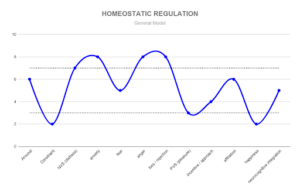
Graph HBR “Homeostatic Regulation profile”
Prototypical psychopathology caused by or associated with homeostatic / behavioral dysregulation involves (i) maladaptive (excessive or insufficient) arousal and constraint (apathy, detachment, reactivity, impulsivity); (ii) high Negative Emotionality (NE) (worry, anxiety, fears, phobias, depression, irritability, aggression); (iii) low Positive Emotionality (PE) (anhedonia, avoidance, isolation) and (iv) neurocognitive impairment (delirium, dementia, schizotypy, neurodevelopmental)
Disturbances of the I / Self
Disturbances of the “I” and “Self” involve perspectival locus (vantage point) of one’s awareness.
Whereas “personality” is a neurocognitive (endophenotype) aspect of UNIQUENESS and the “Self” its aggregated representation (image, schema) encoded in memory, the “I” is the direct experience of one’s own UNIQUENESS (being). The “I/me” is how one’s UNIQUENESS is represented in one’s awareness and experienced in one’s consciousness. The experience of the I” emerges at a particular PERSPECTIVAL LOCUS in one’s awareness as a mutual projection / reflection (interface, reflective projection) of the four REGISTERS of UNIQUENESS onto each other.
PERSPECTIVAL LOCUS of the “I” is an i-state within a particular REGION of the I-STATE reflecting (i) coordinates of one’s spatiotemporal location and (ii) mode (relational channel) of one’s awareness (sensory, affective, ideational, vocal, semantic, kinetic). It is a spatiotemporal, biophysical, phenomenal, interpersonal and societal perspective (vantage point) from which one interacts with one’s sensory and semiotic milieu, including others.
The spatiotemporal coordinates of LOCATION reflect the locus of one’s body in space-time. The MODE is the relational channel within which the LOCUS (of the “I”) is created (formed) and may include any (ontogenetic) configuration of (i) sensory channels (visual, tactile, olfactory, auditory, gustatory, proprioception and interoception); (ii) kinetic channels (movement, action) (iii) affective channels (emotions, feelings), (iv) ideational channels (thoughts, images, concepts, meaning); (v) vocal channels (sounds, speech) and (vi) semiotic (language) channels (signs, language, speech) ( see the Graph PL below).
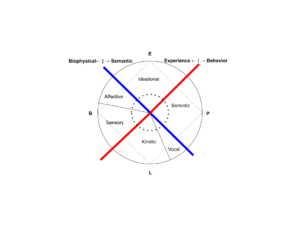
Graph PL “Perspectival Locus”
PERSPECTIVAL LOCUS (i-state) becomes “maladaptive” when the relative activation / inhibition of the relational channels (MODE) is not congruent with the events and relations at the LOCATION (physical, sensory, semiotic and intersubjective milieu). The incongruity is associated with a shift away from the “healthy” (adaptive) center (circle) of the I-STATE tetrahedron equidistant from each of its corners (B, L, E, P) resulting in a maladaptively idiosyncratic awareness (representation) of the “I” and the consciousness of (ideation about) the “Self”.
Prototypical problems associated with the disturbances of the perspectival locus of the “I” and “Self” include problems with spatiotemporal orientation and coordination (e.g. boundaries, shape, position, movement, proximity, direction), identity problems (e.g. gender, age), problems with self / body representation (image, schema) (e.g. cognitive distortions, fragmentation, incongruity, part-representations), dissociation (depersonalization), reality testing (disorientation, derealization, fantasy). Psychopathology of the “I” / “Self” is often related to disturbances of associative integration (coherence, cohesion) of the language of the unconscious “primary process” (displacement / metaphor, condensation / metonymy, fragmentation) and to maladaptive activity of defense mechanisms (denial, splitting, disavowal, projection, repression, somatization, suppression, intellectualization, sublimation).
Dysregulation of interpersonal relatedness
Dysregulation of INTERPERSONAL RELATEDNESS (I-RELATEDNESS) involves problems with (i) Self-Others (Focus, Regard) and (ii) Intersubjectivity.
SELF-OTHERS is an aspect of INTERPERSONAL RELATEDNESS reflecting relative salience (importance) of one’s own vs. others’ BODY, LOCATION, EXPERIENCE, PERSON in one’s consciousness. Salience includes focus (attention) and appraisal (valuation). FOCUS is a relative allocation of attention (and awareness) (frequency, duration) to one’s vs others’ BODY, LOCATION, EXPERIENCE and PERSON and APPRAISAL is their relative valuation (valence) in one’s consciousness. FOCUS is ipsocentric when one’s consciousness is centered mostly on oneself and allocentric when it is centered on others. APPRAISAL is a continuum of valuations and can be “high” (positive) or “low” (negative) (see Graph F-A below).
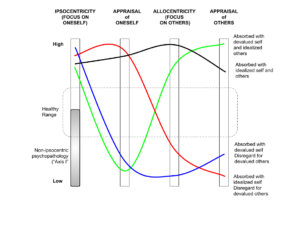
Graph F-A “Self-Others (Focus, Appraisal)”
Distribution of attention (FOCUS) among one’s vs others’ BODY, LOCATION, EXPERIENCE and PERSON is conceptualized as a percentage (%) (presence) of their representations (frequency, duration) in one’s awareness. (see Graph F below)
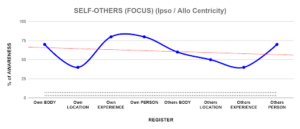
Graph F “Self-Others (Focus)”
APPRAISAL (valence) of one’s vs others’ BODY, LOCATION, EXPERIENCE and PERSON is conceptualized as a “profile” (panel) with a trendline marking their respective relative overall valuations (see Graph A below)
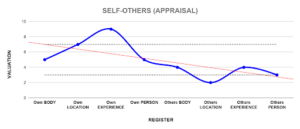
Graph A “Self-Others (Appraisal)”
Ipsocentric FOCUS is one of the main markers of RELATIONAL VULNERABILITY (“Disorders of Personality”) in general and is the most pronounced in the “narcissistic”, “schizoid” and “psychopathic” (“antisocial”) spectra (aspects) of psychopathology.
INTERSUBJECTIVITY is the essential and prototypical aspect of INTERPERSONAL RELATEDNESS encompassing (i) agency, (ii) autonomy, (iii) desire and capacity for intimacy, (iv) love (care) for others (v) transubjectivity and (vi) alterity (otherness).
INTERSUBJECTIVITY manifests one’s relatedness and spatiotemporal, biophysical, experiential and relational POSITION among others (see Graph IS below)
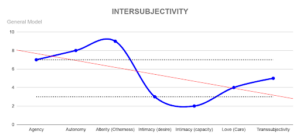
Graph I/S “Intersubjectivity”
Prototypical problems associated with INTERPERSONAL RELATEDNESS include maladaptive (excessive) (i) ipsocentricity / allocentricity (FOCUS) (ii) idealization / devaluation of self and / or others (REGARD), (iii) internalization / externalization (responsibility, blame) (AGENCY), (iv) independence / dependence (AUTONOMY), (v) detachment / attachment (INTIMACY), (vi) devotion / indifference to others (LOVE / CARE), (vii) singularity / communality (TRANSUBJECTIVITY) and (viii) conformity / otherness (ALTERITY).
Exposure to stressors
Increased exposure to STRESSORS (traumas) within one’s sensory and semantic milieu includes any adversity and trauma that contributes to the impairment of associative integration or amplifies relational vulnerability. Prototypical stressors include natural or man-made disasters (earthquake, war), psychological / physical abuse and any persistent adversity including (i) the ecosystem (survival, resources, shelter, poverty); (ii) the society (freedom, responsibility, law, rights, justice); (iii) safety (violence, crime); (iv) health maintenance systems (healing); (v) promotion and pursuit of growth (education, actualization). Acute or chronic stressors can become traumas (See Graph S below)
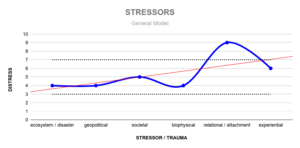
Graph S “Stressors / Trauma”
A simplified graph, with aggregated variables across all aspects of RELATIONAL VULNERABILITY (“disorders of personality”) is below.
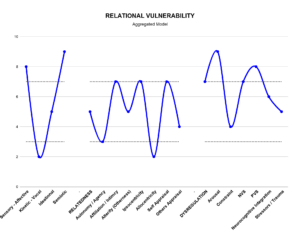
Graph RV-A “Relational Vulnerability – Aggregated Model”