Codes of uniqueness and representation
The four registers of UNIQUENESS – LOCATION, BODY, EXPERIENCE and PERSON anchor and contextualize being and being human in a “reality” of what it means to “exist”, both in each moment of “here and now” and throughout the space-time (of the post Big Bang multiverse). Each register has a distinct role and relevance (centrality, importance) in the formation of (i) one’s uniqueness and (ii) one’s representation of oneself and others.
Centrality of LOCATION (L) implies focus on the spatiotemporal coordinates of location of one’s body and on immediate proximal events, relations and entities within one’s sensory horizon.The body itself is excluded from the location (ex-BODY).
Centrality of the BODY (B) implies focus on the biophysicality of one’s body, including its appearance and behavior. Sensations are typically, but not always, excluded, unless clearly articulated as corporeal / somatic, e.g. “My body is cold / tired” vs “ I am cold / tired”.
Centrality of EXPERIENCE (E) implies focus on primary or secondary experience as the content of one’s consciousness, including sensations, awareness and ideation.
Centrality of PERSON (P) implies focus on societal and interpersonal markers, including records, products and memories.
The relative relevance of each register can be expressed by its position in a sequence of four letters (L-B-E-P) organized in a descending order of centrality from left (high) to right (low). For instance, [LBEP] means that LOCATION is the most central (important), followed, in a descending order of importance, by BODY, EXPERIENCE and PERSON.
There are twenty four unique prototypical configurations (codes) of the four registers.
The six prototypical [Lxxx] configurations (LBEP, LBPE, LEBP, LEPB, LPBE, LPEB) reflect focus on coordinates of location and on proximal events and their mutual relations, including other entities and bodies of others (e.g. GPS, air / street traffic control, flying / driving, ballet, team sports, staged performances).
The six prototypical [Bxxx] configurations (BLEP; BLPE; BELP; BEPL; BPLE; BPEL) correspond to focus on the BODY and it’s biophysicality, appearance and behavior (e.g. medicine, sports, exercising, physical contact, parent-infant interactions, performances, dance, modelling).
The six prototypical [Exxx] (EBLP, ELBP, EBPL, ELPB, EPBL, EPBL) configurations correspond to focus on the primary or secondary experience as the content of one’s consciousness (e.g. sensations, thoughts, feelings, desires, memories.)
The six prototypical [Pxxx] configurations (PBLE, PBEL, PLBE, PLEP, PEBL, PELB) reflect focus on societal markers (e.g. science, media, politics, government, rules, schedules, law enforcement, fame / celebrity, socioeconomic status, history, economy / business, public / institutional order).
Relevance (centrality) signifies the relative presence of each of the four registers in one’s consciousness as marked by focus (vs peripherality), frequency and duration. For example, the prototypical BLEP configuration means that one’s consciousness is focused on the BODY, most of the time, with LOCATION, EXPERIENCE and PERSON represented progressively more peripherally and less often, in a descending order, respectively.
As one moves throughout domains and contexts of one’s life – the public (work, peer groups, community) and the private ([being with] intimate [others]; [being] alone) – centrality and corresponding configurations of registers continuously change, based on inherent fluctuations within each and among all the four registers, in space-time, moment after moment (see Graph below).
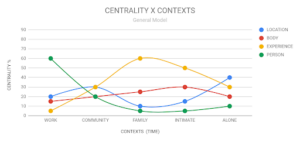
Graph C-C-1 – Centrality and Contexts-1
Domains and specific contexts are coded in front of the registers acronym.
For instance, (work)PBLE; (alone)ELBP might be used for someone who in the work context is focused primarily on the public PERSON followed by the BODY, LOCATION and EXPERIENCE and who,when alone, is focused mainly on own EXPERIENCE, followed by LOCATION, BODY and PERSON, respectively (e.g. traffic officer who, when alone listens to music in a secluded room to relax from daily stress) (See Graph below)
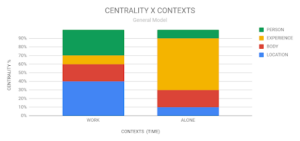
Graph C-C-2 – Centrality and Contexts-2
The flow of actual configurations in time (t), across domains and contexts of one’s life, can be coded as a string of the four registers e.g. (t1)blep-(t2)eblp-(t3)lbpe-(t4)pble-………-(t∞)xxxx, etc., where each moment of time (t) refers to focus (in one’s consciousness) on a specific location (l), biophysical state / behavior of one’s body (b), experience (e) and societal attributes (markers, products, memories). The length of each moment is defined by the time a particular one configuration is detected as new or different (sensory threshold) and maintained in one’s consciousness (attention, working memory).
In addition to representing oneself one also forms representations of others. There may be up to twenty four prototypical [Lxxx]; [Bxxx]; [Exxx] or [Pxxx] prototypical representations of others in one’s consciousness. Together, the representations of oneself and others can form a [24X24] matrix of up to 576 prototypical configurations. As above, the representations are coded as a string of letters, the first four reflecting representations of oneself and the second four, representations of others, with a description of the context (domain) in front of them. For instance, (intimate)BLEP-EBLP for mother-infant vs (intimate)PEBL-EBPL for psychotherapist-patient (See two Graphs below)
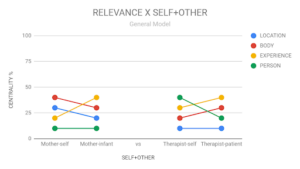
Graph R-S/O – Relevance and Self-Other-1
Other examples, (community)BLEP-LPBE for a race runner vs PBLE-EPLB for a politician at rally; (intimate)BELP-BLEP for sexual encounter vs (intimate)EBLP-ELBP for friends texting.
The number of possible configurations (576) is not the same as the number of actual configurations characterizing one’s unique pattern (focus, frequency, duration) of representing oneself and others. The actual number is significantly lower and corresponds to the range of one’s internal states addressed in a separate post.