Psychopathology is an epi-ontogenetic disturbance (disorder) of associative integration manifested in impairments (symptoms, signs) of Homeostatic Regulation (activation, emotionality, neurocognitive integration) and Interpersonal Relatedness (Self-Others, intersubjectivity). Homeostatic dysregulations are associated with the biophysical (biological) aspects of psychopathology and dysregulated Relatedness underlie its interpersonal manifestations.
Ipsocentricity (focus on oneself) is a central aspect of relatedness and demarcates the distinction (differential diagnosis) between predominantly biophysical (neurocognitive) vs. chiefly interpersonal (relational vulnerability related) aspects of psychopathology. It is a continuum of (i) focus on oneself and (ii) disregard of others, ranging from mild (“neurotic”) to severe (“psychopathic”) which, along with the level of homeostatic regulation, is associated with the variability of phenotypic manifestation and diagnostic spectrum of psychopathology (see Graph RV-I-Dx below).
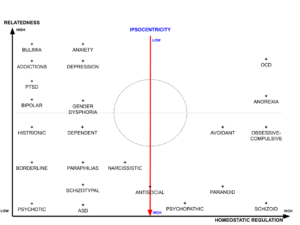
Graph RV-I-Dx “Relational Vulnerability – Ipsocentricity & Differential Diagnosis”
Ipsocentricity is an inverse of Relatedness and “Elevated” or “High” ipsocentricity ( “Decreased”or “Low” relatedness) are associated with relational vulnerability (“personality disorders”), psychotic disorders, ASD and paraphilias, whereas “Decreased”or “Low”” ipsocentricity (“Elevated” or “High relatedness) correspond to mainly biophysical disorders. Additional contrast (differential) is based on the level of homeostatic regulation (“High” for some e.g. for OCD and Anorexia, “Low” for PTSD, Bipolar Disorders, Addictions, Bulimia, Depression, Gender Dysphoria, Anxiety and several other aspects of psychopathology).
Low levels of ipsocentricity (0-25%) typically include elevated capacity for transsubjectivity, generativity, love (care), allocentricity and intersubjectivity (realization of one’s interconnectedness with others).
High levels of ipsocentricity (75-100%) are manifested by self-absorption, entitlement, grandiosity, exploitation, aggression, sadism, psychosis and psychopathy (psychopathology).
Moderate levels of ipsocentricity (around 50%) are considered adaptive and healthy (survival), and involve autonomy, agency, mutuality, empathy and intimacy (actualization)
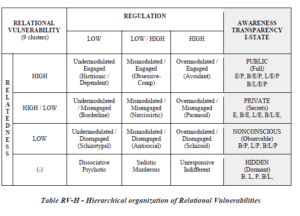
Hierarchical organization of relational vulnerabilities
Each of the nine prototypical types (clusters) or relational vulnerability is present, to a differing degree, within the unique I-STATE of each individual. They are hierarchically organized and can be (i) fully public, transparent and conscious; (ii) private with only partial awareness and transparency, (iii) nonconscious but observable to others and (iv) hidden – nonconscious and opaque to others.
The public layer typically involves aspects of the “Engaged”, socially / interpersonally desirable and acceptable clusters (“Histrionic”, “Dependent”, “Obsessive-Compulsive” and “Avoidant”).
The private layer typically includes aspects of the “Misengaged”, socially controversial / conflictual clusters (“Borderline”, “Narcissistic”, “Paranoid”).
The nonconscious layer contains aspects of the less desirable, “Disengaged” clusters (“Schizotypal”, “Antisocial”, “Schizoid”)
The hidden (dormant) layer shelters aspects of extremely unrelated / unrelatable (-) aspects of the “ Disengaged” cluster that are typically fully unconscious and inaccessible to others and emerge (awaken) only in extreme circumstances. (See Table RV-H) below)
RELATIONAL VULNERABILITY(9 clusters) |
REGULATION |
AWARENESS TRANSPARENCYI-STATE |
|||
LOW |
LOW / HIGH |
HIGH |
|||
RELATEDNESS |
HIGH |
UndermodulatedEngaged (Histrionic / Dependent) |
Mismodulated /Engaged Obsessive-Comp.) |
Overmodulated /Engaged (Avoidant) |
PUBLIC(Full) E/P, B/E/P, L/E/P B/L/E/P |
HIGH / LOW |
Undermodulated /Misengaged (Borderline) |
Mismodulated /Misengaged (Narcissistic) |
Overmodulated/Misengaged (Paranoid) |
PRIVATE(Secrets) E, B/E, L/E, B/L/E, |
|
LOW |
Undermodulated /Disengaged (Schizotypal) |
Mismodulated /Disengaged (Antisocial) |
Overmodulated /Disengaged (Schizoid) |
NONCONSCIOUS(Observable) B/P, L/P, B/L/P |
|
(-) |
DissociativePsychotic |
SadisticMurderous |
UnresponsiveIndifferent |
HIDDEN(Dormant) B, L, P, B/L, |
|
Table RV-H – Hierarchical organization of Relational Vulnerabilities