Prototypical configurations of the four registers correspond to unique patterns (styles) of being and experiencing (representing) oneself and others (“identity”, “personality”) . For instance:
The six prototypical [Lxxx] configurations (LBEP, LBPE, LEBP, LEPB, LPBE, LPEB) correspond to a style (pattern) focused on location, including (i) tangible proximal events (entities, things) and their relations (e.g. geographical locality, nature / aesthetic, physical / material objects l) or (ii) relative position and distance of others and their bodies (e.g. proximity-seeking / avoiding / controlling, reclusive styles).
The six prototypical [Bxxx] configurations (BLEP; BLPE; BELP; BEPL; BPLE; BPEL) correspond to a style focused on the corporeal – action, contact, appearance and/or performative behavior of the BODY (e.g. demonstrative, externalizing, impulsive, (en)acting-out, somatizing, physical contact-seeking / avoiding styles)
The six prototypical [Exxx] (EBLP, ELBP, EBPL, ELPB, EPBL, EPBL) configurations correspond to a style focused on (subjective) experience (e.g. introspective, internalizing, symbolizing, mentalizing).
The six prototypical [Pxxx] configurations (PBLE, PBEL, PLBE, PLEP, PEBL, PELB) correspond to a style focused on public societal markers (e.g. status / image / celebrity / fame; rebellious / exploitative / transgressing vs conforming / protectionistic / enforcing; individualistic / eccentric vs collective / collaborative).
The relevance of each register in the developmental formation of one’s uniqueness and in the construction of representations of oneself and others is is based on a dialectic between the Desire of others – the totality of what others want and desire one to be or do, and one’s own Desire – what one wants and desires for oneself and from others. The boundary between the two is fluid and changes in space-time.
Accordingly, within the dialectic of Desire, and at a particular (sub)cultural LOCATION, the formation and manifestation of gender identity involve (i) the epigenetics, anatomy, appearance and behavior of the BODY (ii) the (subjective) EXPERIENCE of one’s gender and (iii) the societal markers of gender (official records and interpersonal perceptions). Developmental resolutions of the universal tension among (i) biological ambiguities of “gender” of one’s body, (ii) inherent fluidity of one’s experience of own gender, including fantasies about and desires for (being) the “other” gender and (iii) societal markers of gender (binary / fluid / other) lay foundation for eventual formation and expression of gender identity and interpersonal attraction (Desire to be vs Desire to be with (have) the Other) and related interpersonal challenges and problems (psychopathology).
Relationality and intersubjectivity
One exists among others and any dyadic transaction between two individuals X and Y involves a matrix of four sets of representations – representations of oneself and others of individual X and representations of oneself and others of individual Y. Consistently, such a matrix is coded X(domain)xxxx-xxxx><Y(domain)xxxx-xxxx.
For instance, prototypical code X(work)PBLE-BELP><Y(community)EBLP-PBEL might refer to a physician X examining a patient Y at a local emergency room (Graph below);
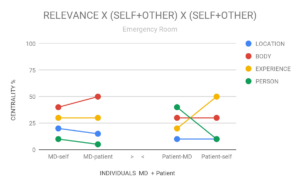
Graph R-S/OxS/O-1 – Relevance and Self-Other X Self-Other-1
X(community)BPEL-BPLE><Y(community)BPEL-BPLE for a first date, in person or virtual, with X and Y in matching configurations (Graph below).
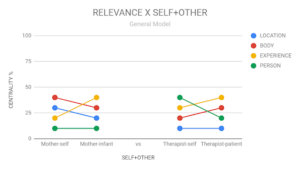
Graph R-S/OxS/O-2 – Relevance and Self-Other X Self-Other-2
or X(intimate)BELP-BELP><Y(intimate)EBLP-PLBE for sexual encounter between a celebrity (X) and a groupie admirer (Y).
The above examples illustrate prototypical dyadic transactions. The actual interactions between two or more individual are extended in time (t1……tn) and would be coded as an expanded version of the formula in footnote #10 above.
Vicissitudes of DESIRE – attraction, relationships, intimacy
Interpersonal attraction, relationships and intimacy are based on DESIRE, the dynamic totality of what one wants (wishes) and longs for (turns to) versus what one is aversive to (turns away from). It is a wish or longing to (i) be (not be) someone / something, (ii) be (not be) like someone / something or (iii) be (not be) with or have (not have) someone / something.
Most fundamentally, DESIRE is for an EVENT or RELATION to be different from what it is (change). Based on evolutionary progression from kinesis, tropism, taxis, reflex, instinct towards needs and “motivation”, wishes and desires are EVENTS within or about (i) one’s BODY (e.g. pleasure, pain, hunger, craving, turning to / away) and (ii) one’s EXPERIENCE (e.g. preference / choice, fantasy, dreams) and reflect EVENTS and RELATIONS within (i) one’s LOCATION (e.g. proximity, distance from / to or physical energy of other entities) and (ii) one’s PERSON (societal / interpersonal markers, demands and expectancies)
Many desires of the BODY are not represented in one’s EXPERIENCE (unconscious) and, correspondingly, many desires in one’s EXPERIENCE never become observable BEHAVIORS (private, secrets). The experience of desiring is quintessentially agentic and intentional, one DESIRES a particular EVENT or RELATION to be different than it is, was or might be, based on one’s experience of insufficiency (lack, absence) of what is.
The matrix of one’s DESIRE is based on the four registers of UNIQUENESS.
One desires through one’s BODY (e.g. drowsiness, hunger, gasping for air), within one’s EXPERIENCE (e.g. loving, hoping, fantasizing ), based on one’s LOCATION (e.g. being homesick) or in response to one as a PERSON (e.g. recognition, status, title, position). Correspondingly, one’s desire can be focused on other’s LOCATION (e.g. physical proximity / distance), BODY (e.g. corporeal beauty), EXPERIENCE (e.g. other’s feelings / ideas) or PERSON (e.g. celebrity, status, wealth).
For instance, lust can be conceptualized as primarily corporeal and coded as LUST=[X]BELP-BPLE, whereas love is often thought of as a more complex experience possibly coded as LOVE=[X]EPBL-PEBL
In the work domain, a hiring decision by a boss X can be based on any of the four REGISTERS and coded HIRE DECISION=[X]PEBL-BLPE for a modelling agency vs HIRE DECISION=[X]PELB-PELB for a college professor.
While attraction is mainly based on one’s Desire, interpersonal dyadic compatibility between two individuals X,Y are based on the degree of similarity of their interpersonal (personality) styles and Desires. Unsurprisingly, two individuals (friends, couple, marriage) with matching styles and Desires are more likely to be compatible and enjoy the relationship than individuals M,F whose styles and Desires are substantially different (see Graphs below)
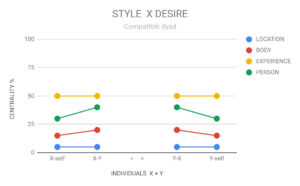
Graph S-D-c – Style and Desire -compatible dyad
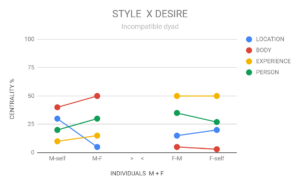
Graph S-D-ic – Style and Desire -incompatible dyad