“Personality”, the “Self “and the “I” are three distinct aspects of one’s UNIQUENESS.
“PERSONALITY” is a neurocognitive endophenotype embedded in one’s body and the brain, the “SELF” is an aggregated representation of oneself (image, schema, narrative, identity) encoded in one’s memory and the “I” is one’s awareness (sensory representation) of oneself in the present moment of the “here-and-now” (“I-State”) (see Graph PSI below)
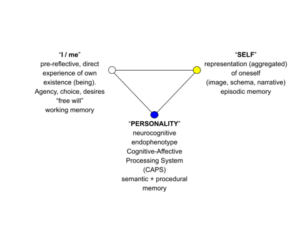
Graph PSI – Personality, Self and the I
PERSONALITY as a neurocognitive endophenotype and the SELF as “self-image” or a “schema” / “narrative “about oneself have been studied for a while and are fairly well understood, however, the “I” as awareness (“proto-consciousness”) of oneself (e.g. “I am” reading this sentence) may need further exploration and clarification.
While “I am reading” or “I like black tea” statements make sense, at least in the English language, “Personality is reading” or “Self likes black tea” statements do not. Correspondingly, “My personality” / “My self” statements do make sense whereas “My I” does not.
What do then the “I” and the “I am” in the above statements refer to (designate, signify)?
Most fundamentally, the “I” / “I am” is one’s awareness (sensation, perception, representation, reflection) of one’s own being (existing). It is an i-state (I-state) within the four REGISTERS and fifteen REGIONS of UNIQUENESS (see Graph RR-I below).

Graph RR-I – Registers, Regions and the “I”
The “I”, “PERSONALITY” and the “SELF” co-construct and reflect (re-flect) each other within the BLCP tetrahedron of one’s uniqueness (Graph PSI-BLCP below).
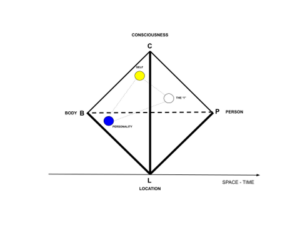
Graph PSI-BLCP – Personality, Self and the I within the BLCP Tetrahedron (Registers / Regions)
Furthermore, the “I”, “PERSONALITY” and the “SELF” constantly co-construct and reflect each other with “BEHAVIOR” (Graph BPSI-BLCP below).
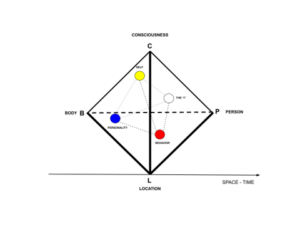
Graph BPSI-BLCP – Behavior, Personality, Self and the I within the BLCP Tetrahedron (Registers / Regions)
The “I” and the “I am” (being).
The “I” is one’s awareness (sensation, representation, reflection) of an aspect of one’s own uniqueness in the present moment of the here-and-now. It is (i) a manifestation (the totality of) one’s uniqueness across the four Registers (BODY, LOCATION, CONSCIOUSNESS, PERSON); (ii) an i-state within the fifteen regions of the BLCP tetrahedron; (iii) one’s direct (“pre-reflective”) awareness (“proto-consciousness”) of the boundary of own body (biophysical autonomy); (iv) a representation (awareness) of an aspect of one’s own uniqueness and ideation (thoughts, images) about it (“self-consciousness”) and (v) a sign (pronoun “I”, “you, she/he”) used to refer to (designate, point to) one’s uniqueness (individuality, autonomy, separateness) in language and communication[1].
The “I” can be experienced in an infinite number of ways (positions) clustering within the BLCP tetrahedron and the 15 regions of uniqueness. Specific experience (position) of the “I” in each unique moment of the here-and-now is reflected (re-flected, revealed + determined) by the focus of attention based on events within one’s (i) sensory / semiotic location and (ii) consciousness (awareness, ideation).
The “am” (being) in the “I am” is one’s awareness (sensation, reflection) of one’s own existence (being) and agency (“free will”). It is predicated on what it means “to be” and “to be human and a human being”. Being human (to pass the test of “being” human) means (i) to have a (human) body occupying a spatiotemporal location, (ii) to have (an experience of) human consciousness and (iii) to be experienced and marked as a human being by others.
More broadly, the formation of the “I” and the experience of being (“I am”) are part of the evolutionary progression of the physical world towards nature, life, culture, civilization and the formation of awareness (representation, reflection) of itself as human consciousness. In time, the sensation and awareness of the “I” / “I am” have evolved in the service of survival and adaptation within the ecosystem on the surface of the Earth. Furthermore, since there is no known limit to human consciousness, the natural, evolutionary and societal transformations of the physical world (multiverse) towards and by progressively more complex aspects of human experience, consciousness and culture (products, science, technology) currently include the new and emerging VR (Virtual Reality) technologies exploring the possibility of a virtual (alternative, simulated) replica (add-on) of the physical world and consciousness themselves.
The formation of the “I” and the experience of being (“I am”) can only arise and function within the subjective perspectival point of view and become “you”, “she / he” within the interpersonal and the academic perspectives. However, the “one” (“me”), the “I” (subjective), “you” / “she / he” (interpersonal and academic) designate (point to) one spatiotemporal moment (part, location, fragment) of the Universe formed, demarcated and signified as one’s individuality (uniqueness) by its four Registers (BODY, LOCATION, CONSCIOUSNESS, PERSON) (ontology). The “phenomenology” of the experience of the “I” is not the same as the “ontology” (being) of the “I” as one’s UNIQUENESS (unique being). The phenomenal consciousness (experience) of the “I” is based on a dis-association (ex-istence) from its ontic existence (being) at a particular spatiotemporal location among others. The phenomenal, subjective experience, representation and articulation of the “I” can only include those aspects of one’s UNIQUENESS that are accessible to one’s senses, awareness and consciousness (known) whereas the ontic and ontological aspects of it are the totality (conscious / nonconscious, private / public, known / unknown) of one’s individuality and existence (unique being, uniqueness).
Biophysicality / Signification / Experience / Behavior matrix and the corresponding six basic modes of the formation of the “I” / “I am” (Sensory, Kinetic, Vocal, Affective, Ideational, Semiotic / Communicative)[2] (Graph PL below) are now expanded to include the fifteen regions of UNIQUENESS within which the formation of the “I” / “I am” takes place (eight conscious (“I” / “I am”) and seven nonconscious (you, she / he) (Graph P-I-(R) below).
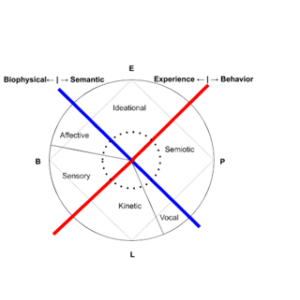
Graph PL “Perspectival Locus”
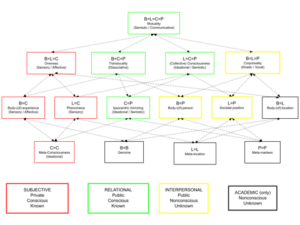
Graph P-I-(R) – Perspectival formation of the “I” / “You” / “She / He” / “We“
within the fifteen Regions
The “I” manifests a region of one’s UNIQUENESS experienced by one at any given moment of the here-and-now. The formation of the “I” is (i) exclusively subjective (as in “I am”) in regions B=L=C (Oneness / Qualia); B=C (Body-(of)-Experience); L=C (Phenomena) and C=C (Meta consciousness, HOT); (ii) exclusively interpersonal (as in “you” “she / he”) in regions B=L=P (Corporeality); B=P (Body-(of)-Person) and L=P (Societal position) and (iii) relational (intersubjective) (as in “we / us”) in regions B=L=C=P (Mutuality); B=C=P (Translocality); L=C=P (Collective consciousness) and C=P (Ipsocentric mirroring). All perspectives and all fifteen regions can be involved in the formation of the I” / I am” (as “she / he”) within the academic perspective, however, regions B=L (Body-(of)-location); B=B (Genome); L=L (Meta-location) and P=P (Meta-markers) are typically exclusively academic (as in “she / he”).
The location of the phenomenal “I” is typically revealed in the verb, noun or adjective following it. For instance, “I am hungry” reflects the “sensory position”; “I am thinking” “ideational”; “I am jumping” “kinetic”; “I announce” “communicative”; “I am angry” “affective”, etc.
The subjective experience of the “I” constantly changes and may disappear from one’s awareness (e.g. Zen kensho), however, within the interpersonal / academic perspective, the “you” or “s/he” of one’s UNIQUENESS, exists as long as the PERSON (markers, records, products) continue to exist among others[3].
[1] Exploration of (i) the “absolute” signified (the physical world, formlessness, emptiness); (ii) the “primary” signified (individual uniqueness) and (iii) the primary signifiers (“I” (“you”, she/he”) is below.
[2] See previous posts
[3] Since the “I” is one’s UNIQUENESS, the “no-I” (“no-Self” / “selflessness”) is not possible as long as the Register of PERSON remains among others.