Psychopathology is (i) an expression and (ii) a study of maladaptive dysregulation (dis-order, impairment) of one’s BODY (biophysical functions, appearance, behavior) and EXPERIENCE (sensations, affects, awareness, ideation), in a PERSON among others, across multiple LOCATIONs.
It is (i) subjectively experienced and represented in one’s consciousness as symptoms; (ii) observed and represented by others as one’s interpersonal behavior and appearance (signs / problems) and (iii) studied and researched academically as syndromes and disorders with hypothesized etiology, course, prognosis and cure (diagnosis). Psychopathology can be associated with (i) problems of adaptation (survival), including capacity for needs fulfilment, self-care, autonomy, agency, intimacy, relatedness, competence and productivity; (ii) problems with actualization (happiness) of one’s desires, creativity and potential and (iii) problems of realization (wisdom), including capacity to transcend the individuality (separateness) and uniqueness of one’s own being.
Psychopathology is an aspect of UNIQUENESS and is conceptualized here as an unfolding of an internal / interpersonal state (I-STATE).
Internal / interpersonal state
I-STATE is what and how one is (becomes) in space and time.
It is a spatiotemporal and ontogenetic progression of EVENTS including biophysical processes and behavior (BODY), activity of consciousness (EXPERIENCE), societal markers (PERSON) and related events within one’s sensory horizon (LOCATION) reflecting (representing and affecting) each other.
Topographically, I-STATE can be conceptualized as a modified Venn diagram (Venn-m) with 15 distinct regions (sets) (see graph below)
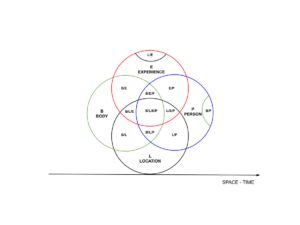
Each region represents a spatiotemporal aspect and ontogenetic / developmental stage of the I-STATE progressing (changing) in focus, complexity and integration (coherence) from Level 1 through Level 4.
Level 1. Regions B, L, E, P
Events take place in only one REGISTER (1=>1)
The B region represents events of the BODY (e.g. metabolism, homeostatic regulation, associative memory, neurocognitive activity, nonconscious (private) behavior and appearance, the Unconscious, Id) which can be independent from the LOCATION, EXPERIENCE and the PERSON
Region B reflects the BIOPHYSICALITY of being and being alive.
The L region represents natural and man-made events at a particular LOCATION (e.g. environment, climate, community, population, language, culture) which are typically independent from one’s BODY, EXPERIENCE and the PERSON .
Region L reflects the SPATIOTEMPORALITY of one’s being and life.
Region E represents autonomous events in one’s CONSCIOUSNESS (e.g. thoughts, dreams, fantasies, reveries, illusions, hallucinations) that can be independent from one’s BODY, LOCATION and the PERSON . Region E reflects the autonomy of CONSCIOUSNESS.
Region P represents markers of one as a PERSON (e.g. stories, expectations, commemoration, records, products, memories, reputation, stereotypes, misrepresentations, rumors, mistaken identity, SEC status, celebrity, fame, prejudice, stigma) which can be independent from one’s actual BODY, LOCATION or EXPERIENCE. Region P reflects the OTHERNESS (separateness) of others.
Level 2 Regions B/E, B/P, E/P, B/L,L/E, L/P
The same one (1) event functions (exists) in two (2) different REGISTERS (1=>2)
In the B/L region the BODY and LOCATION overlap (e.g. coordinates of position, sensory space, gravity, diurnal rhythms, instincts, reflexes, ). The B/L events can be independent from EXPERIENCE and the PERSON and reflect the fundamental identity (interface) of one’s SPATIOTEMPORAL and BIOPHYSICAL positions.
It is the spatiotemporality of one’s biophysicality and the biophysicality of one’s spatiotemporality.
In the course of one’s life, the B/L region is always “on” (active) and typically co-occurs with events in other regions.
In the B/E region, the BODY and EXPERIENCE overlap (e.g. sensations, affects, desires) and can be independent from the PERSON and LOCATION . The B/E region is the interface of one’s BIOPHYSICALITY and CONSCIOUSNESS. It is the biophysicality of one’s experience and the experience of one’s biophysicality.
In the B/P region, the BODY and the PERSON overlap (e.g. sex, age, race, behavior, appearance) and can be independent from one’s EXPERIENCE and LOCATION The B/P region reflects the relation between one’s BIOPHYSICALITY and its markers among others (OTHERNESS, otherness-of/for-others). It is the societal POSITION of one’s biophysicality and the biophysicality of the POSITION.The B/P region is always “on” and co-occurs with events in other regions.
In the L/P region, LOCATION and the PERSON overlap (e.g. place of birth, address, nationality) and are independent from one’s BODY and EXPERIENCE. The L/P region reflects the interface of SPATIOTEMPORALITY and societal markers of the PERSON (OTHERNESS). It is the location of one’s POSITION and the position of one’s LOCATION (spatiotemporal / societal POSITION).
The L/P region is always “on”, active in the course of and beyond one’s life (among others).
In the L/E region, one’s LOCATION (the “outside”) and EXPERIENCE (the “inside”) overlap as awareness of one’s sensory space (e. g. color, shape, movement, space, time, temperature,position) in a mutual co-construction of one’s perception of reality, (e.g. “here”, “now”, “thing”, “up/down”, “me/my”, “other”, “home”), independently of the BODY and the PERSON. Region L/E reflects the interface of SPATIOTEMPORALITY and CONSCIOUSNESS (perspectival POSITION of one’s consciousness). It is one’s experience of one’s LOCATION (spatiotemporal position) and the (perspectival / spatiotemporal) position of one’s EXPERIENCE.
In the E/P region, EXPERIENCE and the PERSON overlap as the relation between one’s interpersonal / societal markers and one’s consciousness (e.g. identity, group membership, sameness / otherness, acceptance / rejection), independently of the BODY and LOCATION . Region E/P reflects the interface of societal markers and CONSCIOUSNESS. It is one’s EXPERIENCE of oneself as a PERSON and the markers (PERSON) of one’s EXPERIENCE (intersubjective POSITION)
Since all but two Level 2 regions are always “on”, the degree of their coherence (integration vs dissociation) is relevant to psychopathology and is addressed below.
Level 3 Regions B/L/E, B/L/P, B/E/P, L/E/P
The same one (1) event exists in three of four REGISTERS (1=>3).
In the B/L/P region the BODY, LOCATION and the PERSON overlap in the absence of (related) EXPERIENCE (e.g. fetus / newborn, passing out / fainting, sleep, automatic (nonconscious) action, “body language”, posthumous events, one’s funeral). Combined with the B, L, P, B/L, L/P, B/P, the B/L/P region represents the totality of non-conscious (unexperienced) aspects of the I-STATE.
The four defining attributes of B/L/P are:
(i) biophysical and spatiotemporal markers (B/L) correspond to public markers (P)
(ii) biophysicality and public markers (B/P) correspond to a specific location (L)
(iii) spatiotemporal and public markers (L/P) correspond to biophysicality (B)
(iv) events in the B/L/P region are not represented in one’s awareness
The B/L/P region is always “on” and reflects the autonomy of one’s BIOPHYSICALITY, SPATIOTEMPORALITY and OTHERNESS from one’s EXPERIENCE and CONSCIOUSNESS. The B/L/P region represents aspects of functioning (being) taking place outside of one’s awareness (non-conscious). It is one’s bodily, spatiotemporal and societal POSITION.
In the B/L/E region, the BODY, EXPERIENCE and LOCATION overlap (e.g. pain, pleasure, hunger, attraction, revulsion, musculoskeletal ) and are not reflected in the markers of the PERSON (unobservable). Combined with B, L, E. B/L, B/E, L/E, the B/L/E region represents the totality of one’s private (unobserved, unwitnessed) life.
The four defining attributes of B/L/E are:
(i) biophysical and spatiotemporal markers (B/L) correspond to one’s consciousness (E),
(ii) sensation, affects and desires (B/E) correspond to a specific location (L)
(iii) perception (construction) of reality (L/E) corresponds to biophysicality (B)
(iv) events in the B/L/E region are private and not observable to others.
The B/L/E region is the interface of SPATIOTEMPORALITY, BIOPHYSICALITY and CONSCIOUSNESS and represents primal (unrelated to others) aspects of survival, adaptation, life and being. It is one’s bodily, spatiotemporal and experiential POSITION.
In the B/E/P region the BODY, EXPERIENCE and the PERSON overlap and are autonomous from of one’s LOCATION (e.g. spatiotemporal dislocation / violation, trespassing, disorientation, travel, remote contact). Combined with B, E, P, B/E, E/P, L/E, the B/E/P region represents the capacity for autonomy from the (coordinates of) spatiotemporal location.
The four defining attributes of B/E/P are:
(i) sensation, affects and desires (B/E) correspond to their public markers (P)
(ii) biophysicality and societal / interpersonal markers (B/P) correspond to one’s consciousness (E)
(iii) consciousness and public markers (E/P) correspond to one’s biophysicality (B)
(iv) events in the B/E/P region are independent of or transgressive of one’s location (L)
The B/E/P region reflects the autonomy of BIOPHYSICALITY, CONSCIOUSNESS and societal / interpersonal markers (OTHERNESS) from one’s spatiotemporal LOCATION and represents phylogenetic and ontogenetic capacity to function independently of one’s immediate surroundings. The two aspects of LOCATION, the spatiotemporal coordinates and the sensory horizon (space) are separated (dis-associated). It is one’s experiential and interpersonal / societal POSITION.
In the L/E/P region EXPERIENCE, LOCATION and PERSON overlap and are autonomous from one’s BODY as the relation between one’s awareness, spatiotemporal position and interpersonal / societal markers (e.g. reality testing, remote / virtual interaction, social media). Symbols, language, science and technology allow one to “exist” as a unembodied presence among others (narrative, story, text, audio, video or virtual recording).
Combined with L, E, P, L/E. L/P, E/P, the L/E/P region represents the capacity for autonomy from one’s BODY.
The four defining attributes of L/E/P are:
(i) perception (construction) of reality (L/E) corresponds to societal / interpersonal markers (P)
(ii) spatiotemporal and societal / interpersonal markers (L/P) correspond to one’s consciousness (E)
(iii) one’s consciousness and societal / interpersonal markers (E/P) correspond to a specific location (L)
(iv) events in the L/E/P region are autonomous from one’s biophysicality (B)
The L/E/P region reflects the autonomy of SPATIOTEMPORALITY, CONSCIOUSNESS and OTHERNESS from one’s BIOPHYSICALITY and represents the interface of consensual reality and intersubjectivity (spatiotemporal, experiential and intersubjective POSITION).
Level 4 Region B/L/E/P
The same one (1) event exists in four (4) REGISTERS (1=>4).
The B/L/E/P region reflects events where all four registers (BODY, LOCATION, EXPERIENCE and PERSON) overlap and mutually reflect and co-construct each other in the formation of one’s biophysical, spatiotemporal, experiential and interpersonal POSITION. (e.g. being fully present “here and now” with and among others, intimacy, relatedness“, teamness”)
The B/L/E/P region reflects the mutuality of SPATIOTEMPORALITY, BIOPHYSICALITY, CONSCIOUSNESS and OTHERNESS.