Most broadly, “gender” and “sexual orientation” refer to the biological / evolutionary, societal / cultural and interpersonal / inter-subject-object-ive dimension (continuum) of the female – male (feminine – masculine) and how it manifests and functions as a cluster of specific i-states within one’s uniqueness.
“Gender” points to where and how on the female – male continuum one is, wishes (desires) to be, is perceived or expected to be. It is being, a desire or expectation to be or a perception of being in a particular manner, at a marked (unique) position of, or with respect to, the feminine – masculine.
As an aspect of uniqueness, gender is one’s perspectival (subjective, interpersonal, academic) positionality on the female – male continuum, within the BLCP tetrahedron.
“Sexual orientation” refers to one’s sexual, emotional, romantic (love) response (attraction) to others within the feminine – masculine continuum. It is a desire to “be with”, to “have” or to “love / be loved by” an other who is perceived to inhabit a particular position (cluster) of the feminine – masculine[1]. As an aspect of uniqueness, sexual orientation is a particular perspectival (subjective, interpersonal, academic) position, within the BLCP tetrahedron, of one’s desire or preference for others who are perceived to manifest (embody) a particular aspect (version) of the feminine – masculine (gender position).
Sexuality, gender and sexual orientation are aspects of one’s uniqueness manifesting as overlapping clusters of i-states within the BLCP tetrahedron. They are inherently perspectival and the experience, perception and understanding (construction) of each of them usually varies between the subjective, interpersonal and academic points of view (Graph SGS-O below).
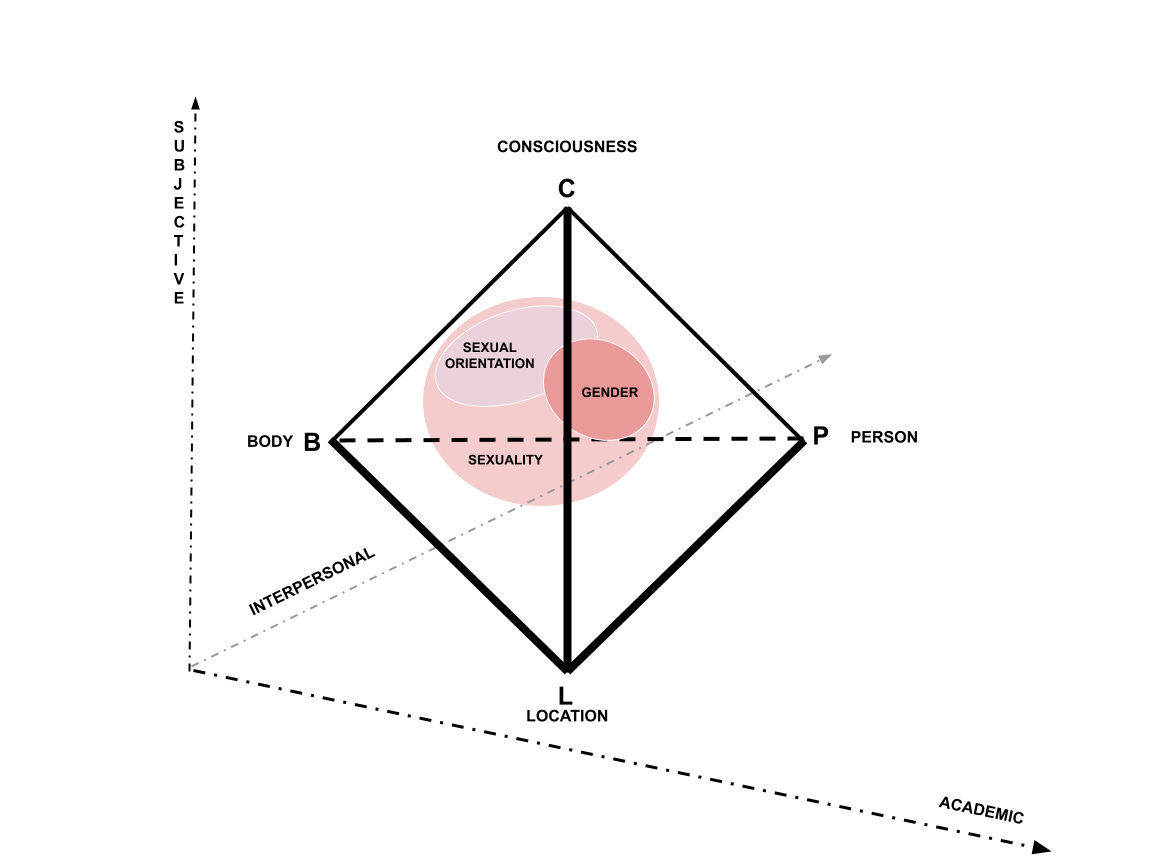
Graph SGS-O – Sexuality, Gender and Sexual Orientation
Formation of one’s unique “gender” and “sexual orientation” is individually unique and involves one’s (i) BODY (developmental epigenetics, anatomy, biophysicality, behavior, appearance); (ii) LOCATION (sensory / semiotic influences, culture, family values / beliefs, parenting, peer group); (iii) CONSCIOUSNESS (sensations, attention, awareness, ideation, thoughts, fantasies) and (iv) the PERSON (interpersonal / societal markers of gender and one’s gender by others).
Gender and sexual orientation are part of the formation and positionality of the “I” and, as such, manifest unique (i) levels of insight (nonconscious, pre-reflective, conscious); (ii) mode (sensoriaffective, sensorimotor, ideational, communicative); (iii) spatiotemporal position (here-now, dis-associative, private, public) and (iv) form (rigid, fluid, multifaceted, formless).
Level of insight reflects one’s awareness, articulation and understanding of own gender and sexual orientation within the “I”, the mode is a particular unique configuration (proportion) of the sensoriaffective (I feel “female – male”), sensorimotor (I act / behave like “female – male”), ideational (“I think as “female – male”) and communicative (I communicate like “female – male”) aspects in their formation, the spatiotemporal position reflects how gender and sexual orientation participate in (public) or are dis-associated (private, nonconscious) from one’s here-now and the form refers to their fluidity, complexity, flexibility and openness to change.
Clusters of gender and sexual orientation overlap within the BLCP tetrahedron but are not anchored at a particular one position and change spatiotemporally based on the state (events and relations within each) of the four Registers and fifteen Regions of one’s uniqueness.
For instance, one may be, or seems to be, manifesting different aspects of the female – male continuum of both gender and sexual orientation based on current biophysicality of the body (arousal, fatigue, affective state, time), location (presence of specific others, private vs public, familiarity, safety, ambiance, norms), consciousness (self-image, thoughts, fantasies, idealization / devaluation of self / others) and the societal / interpersonal position (power, celebrity, roles, prohibitions, opportunities).
The subjective aspects of gender and sexual orientation are inherently ipsocentric and reflect one’s Desire (conscious, nonconscious) for idealized (imagined, fetishized) gender related i-states (i) within oneself (the “I”, “Self”, “personality”, behavior) and (ii) in distinct others perceived to embody (manifest) them. The Desire for particular positionalities of gender and related sexual orientation(s) may reflect (i) an absence (lack) of the desired aspects (features) among one’s i-states; (ii) one’s perception of and belief in their absence (lack) or (iii) one’s refusal or failure to acknowledge their presence and / or availability (dis-association).
Alterity, jouissance and sexuality
The Desire for a particular position of own gender and related sexual orientation are predicated on pleasure / pain of (being) “me” vs “not me” aspects of one’s uniqueness. The “me – not me” distinction (alterity, otherness) is a foundation of biological singularity of an organism and individual uniqueness of being and being human. Desiring reflects what one experiences as and deems to be “pleasurable”.
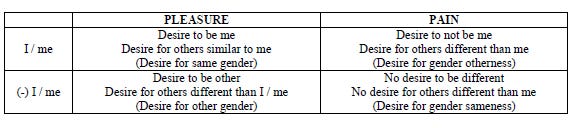
Gender is one’s mark (position) of “me vs not me” on the female – male dimension resulting in a fundamental experience of pleasure (comfort) and affiliation (belonging, safety) vs pain (distress) and alienation. It is one’s construction of “me vs not me” superimposed on one’s construction of the female – male (see table below)
|
|
PLEASURE |
PAIN |
|
I / me |
Desire to be me Desire for others similar to me (Desire for same gender) |
Desire to not be me Desire for others different than me (Desire for gender otherness) |
|
(-) I / me |
Desire to be other Desire for others different than I / me (Desire for other gender) |
No desire to be different No desire for others different than me (Desire for gender sameness) |
To the extent one moves towards “pleasure” and away from “pain”, desire for the “same” (specific) gender is based on pleasure (comfort) and is different from the desire for (non-specific) gender “sameness” based on pain (distress). Correspondingly, desire for “other” (specific) gender is based on pleasure and not the same as desire for (non-specific) gender “otherness” based on pain (distress)
Gender and sexual orientation are interrelated and mutually reflect each other. Sexual orientation directed towards “other” gender is related to one’s desire (conscious, nonconscious, dis-associated) for “otherness” of own gender (gender “dysphoria”) whereas sexual orientation directed towards the “same” gender reflects one’s desire for “sameness” of own gender (gender “affirmation”).
Desire for the “same” gender (for others perceived by one as embodying the “same” gender position as one does) is different from the desire for gender “sameness” (perceived absence of gender alterity / otherness between one and others).
Correspondingly, desire for an ”other” gender (for others perceived by one as embodying specific gender position, “different” from one’s own) is different from the desire for a gender “otherness” (perceived gender alterity / otherness between one and others) (see Graph A-J-S below).
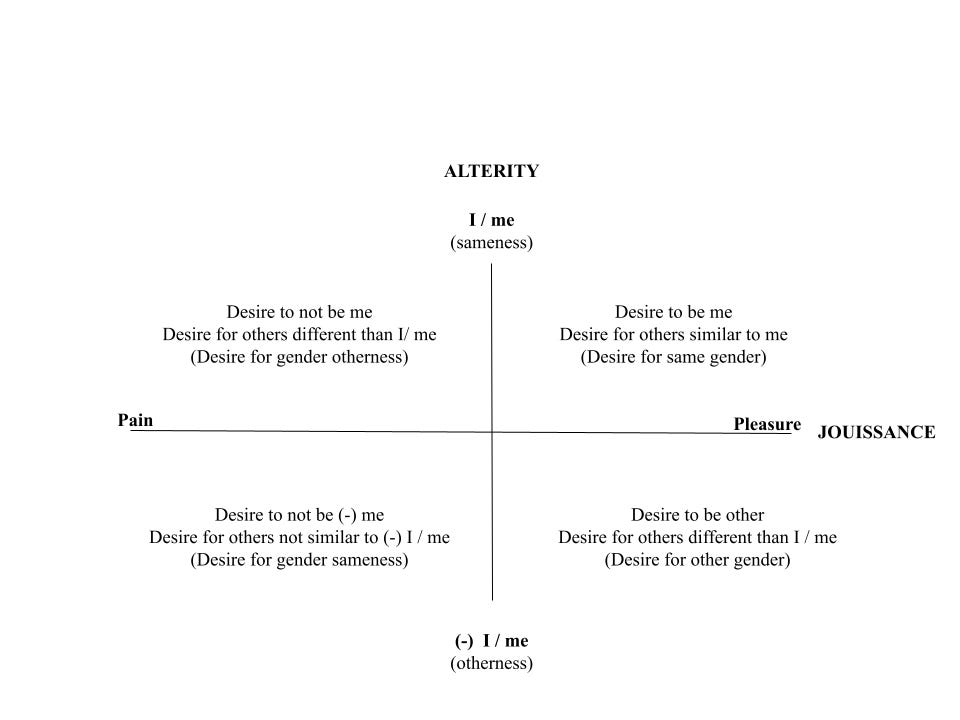
Graph A-J-S – Alterity, Jouissance and Sexuality
Perspectival positionality of gender and sexual orientation
Sexuality, gender and sexual orientation are aspects of one’s uniqueness manifesting as overlapping clusters of i-states within the BLCP tetrahedron. They are perspectival and their experience, perception and understanding (construction) vary between the subjective, interpersonal and academic points of view.
Each of the three perspectives focuses on particular aspects of one’s gender and sexual orientation within the four registers and 15 regions of the BLCP tetrahedron of one’s uniqueness.
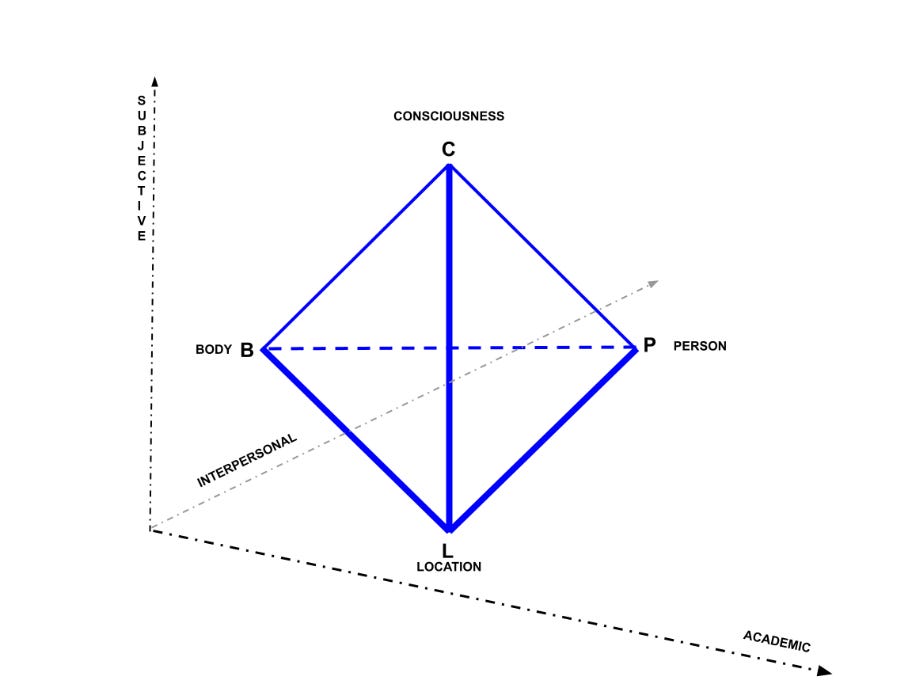
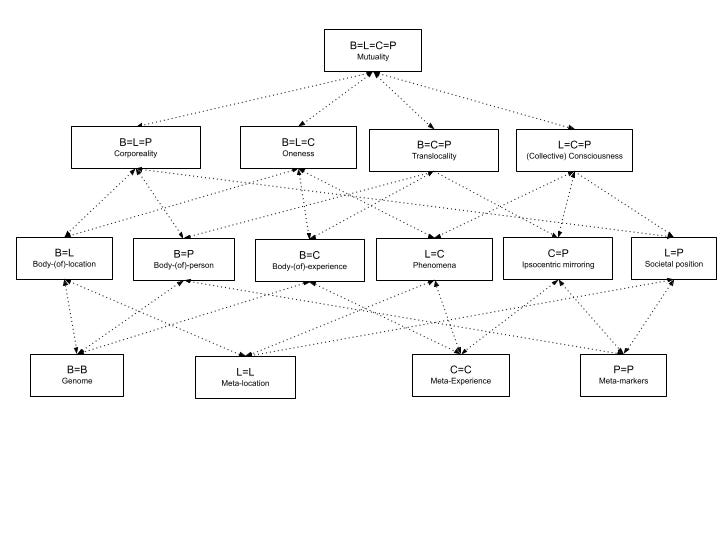
The subjective perspective revolves around the formation of one’s gender and sexual orientation as (i) the here-now of one’s “I” (insight, mode, position, form); (ii) one’s self representation (image, concept, schema, narrative), (iii) personality (neurocognitive structure and functioning) and (iv) behavior (appearance). Although all four registers are always active, the interface of biophysicality / appearance of one’s body (B) and one’s consciousness (sensations, awareness, ideation) (C) and regions B=L=C, B=C and C=C are central in the construction of fundamental subjectivity of one’s own gender.
The interpersonal perspective revolves around perception of one’s gender and sexual orientation by others, mainly based on one’s (i) behavior and appearance (B), (ii) location (L) and (iii) already existing interpersonal / societal markers (P). Registers B, L, P and regions B=L=P, B=C=P and C=P are central in the construction of societal / interpersonal representations of one’s sexuality, including gender and sexual orientation.
The academic perspective on one’s gender and sexual orientation revolves around current and evolving understanding of human sexuality within the contemporary academic discourse. Registers B, L, P and regions B=L, B=B, L=L and P=P are main areas of focus in the academic study of gender and sexual orientation.
Gender, health and psychopathology
As all aspects of uniqueness of being, any particular formation of gender and sexual orientation positions on the female – male (feminine – masculine) continuum can be experienced and perceived as healthy or as a disruption of the here-now which may be deemed to be a manifestation of psychopathology (symptom, sign, marker), subjectively, interpersonally or academically.
Subjectively, one can experience any aspect of own idiosyncratic gender and / or sexual orientation to be “healthy” or a “problem” (disruption) of one’s being in the here-now. Interpersonally, others can perceive any aspect of one’s gender or sexual orientation position to be “healthy” or a “problem” (disruption) of one’s being in the here-now among others.
Academically, any particular formation and / or positionality of gender and sexual orientation can be viewed as ontologically healthy (AAR model of adaptation / actualization / realization) or a disruption of the subjective and / or interpersonal here-now which then may or may not be deemed to be a manifestation of psychopathology.
Resilience of the ontological health of gender and sexual orientation is predicated on one’s (i) capacity for autonomous life (adaptation); (ii) capacity for growth and fulfillment of own potential (actualization) and (iii) capacity for transsubjective compassion / care for others (realization, wisdom) (Table (S-P)! below).
Severity and complexity of pathological and non-pathological disruptions of the here-now related to gender and sexual orientation are based on the number of perspectives (subjective, interpersonal, academic) in which the disruptions are experienced, perceived and deemed pathological.
Because of the societal / interpersonal / subcultural / subgroup normative expectations and demands, significant aspects of gender and sexual confusion, conflicts, ambivalence are often nonconscious (repressed, dis-associated, stereotyped, externalized) with derivative i-states of anger / hate, fear, anxiety, paranoia often resulting in societal / interpersonal bias and strife.
[1] “Sexual orientation” is a response (attraction) to one’s perception of a particular gender position of others.