Severity of psychopathology (level of disruption of the here-now), both in general and disorder-specific, has often been conceptualized by referring to frequency of recurrence, intensity of distress, chronicity (duration), level of functional impairment, prognosis and treatment outcomes.
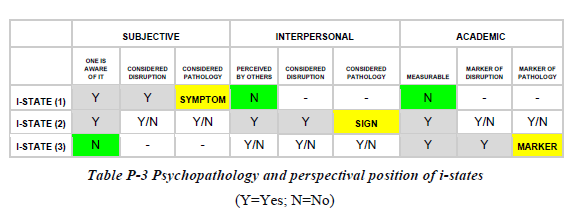
Perspectival aspects of psychopathology add another vantage point from which severity can be categorized as “Low” (1), “Moderate” (2) or “High” (3) corresponding to the number of perspectives (subjective, interpersonal, academic) within which a disruption of the here-now is deemed to be psychopathological (symptom, sign, marker) (see Graph S-P-1 below).
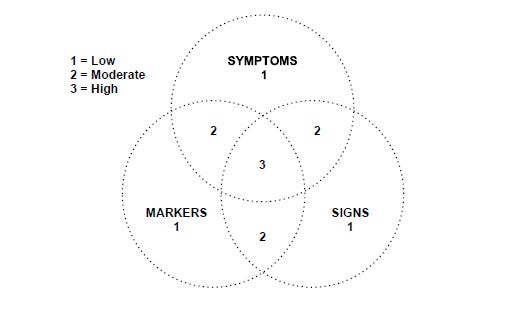
Graph S-P-1 Severity of Psychopathology (1)
A disruption deemed to be a manifestation of psychopathology within only one of the three perspectives – either as a subjectively experienced symptom, interpersonally perceived sign or an academic marker is categorized as “Low” (Level 1). A disruption deemed to be psychopathological within two of the three perspectives – as a symptom and a sign, a symptom and a marker or a sign and a marker is categorized as “Moderate” (Level 2). A disruption perceived and deemed to be psychopathological within all three perspectives – as a symptom, sign and a marker is categorized as “High” (Level 3). For example, anxiety, despair or anger would be categorized as (i) “Low” severity if experienced subjectively as a symptom (psychopathological disruption) but not observable to others; (ii) “Moderate” severity if deemed psychopathological with two of the three perspectives (subjective, interpersonal, academic) and (iii) “High” severity if experienced and deemed psychopathological subjectively, interpersonally and academically.
Furthermore, severity of psychopathology is predicated on how many of the three components of ontological health (adaptation, actualization, realization) are deemed to be affected by a disruption, subjectively, interpersonally or academically, “Low” for one; “Moderate” for two and “High” for three (see Graphs P-4 and S-P-2 below).
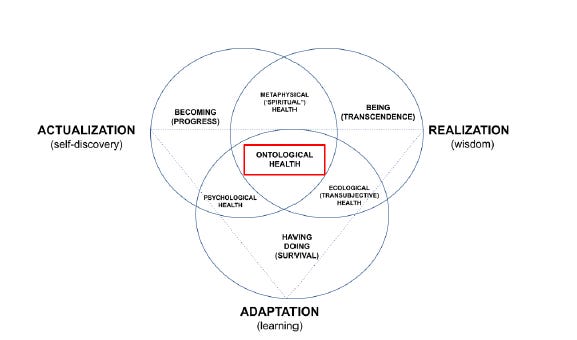
Graph P-4 Psychopathology and Health
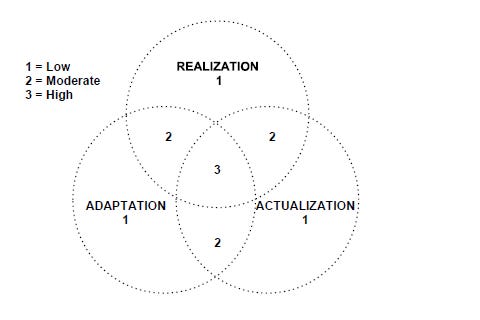
Graph S-P-2 Severity of Psychopathology (2)
Combining the two indicators of severity renders a complex permutational matrix of (i) levels and (ii) types of psychopathology based on the perspectival position (subjective, interpersonal, academic) and ontological health (adaptation, actualization, realization) (see Table (S-P)! below)[1]

|
|
SUBJECTIVE | INTERPERSONAL | ACADEMIC |
|
ADAPTATION |
YES / NO | YES / NO |
YES / NO |
|
ACTUALIZATION |
YES / NO | YES / NO |
YES / NO |
| REALIZATION | YES / NO | YES / NO |
YES / NO |
Graph (S-P)! Severity of Psychopathology (permutational matrix)
The highest level of severity corresponds to disruptions deemed pathological across all three aspects of health and three perspectival positions. It is any disruption of adaptation, actualization and realization deemed psychopathological subjectively, interpersonally and academically. The lowest level of severity (ontological health) corresponds to the absence of disruptions across all aspects of health and perspectival positions.
[1] Types of psychopathology are further diversified based on the 15 regions of the BLCP tetrahedron resulting in the (3 X 3 X 15)! permutational matrix for future research where only some but not all permutations will have actual clinical significance (utility).