In general, ipsocentricity refers to one’s focus on one’s own uniqueness where one is both the “subject” and the “object” of one’s own activity. Ipsocentric i-states include (i) ipsocentric consciousness and (ii) ipsocentric acts – both focused predominantly on the four Registers of one’s own uniqueness.
Ipsocentric consciousness refers to one’s consciousness (sensations, awareness, ideation) focused on the four registers of one’s own uniqueness (“me”, “self”). One is predominately preoccupied with one’s biophysicality (soma) or appearance (BODY); one’s own subjective experiences, thoughts, fantasies (CONSCIOUSNESS); one’s immediate surroundings (LOCATION) and one’s societal / interpersonal markers (PERSON). Ipsocentric consciousness may involve (i) sensory salience – one’s sensations prioritized over sensations of others and / or sensations about oneself prioritized over sensations about others; (ii) attentional focus – one’s attentional focus prioritized over focus of others and / or attention focused on oneself prioritized over focus on others; (iii) awareness – one’s awareness prioritized over awareness of others and / or awareness of oneself prioritized over awareness of others; (iv) ideation – one’s ideation prioritized over ideation of others and / or ideation about oneself prioritized over ideation about others; (v) relative relevance – one prioritizes oneself over others across the four Registers (as more “unique / important / valued / desirable”).
Ipsocentric acts are relational behaviors involving (i) intersubjective ipsocentricity – engaging others’ consciousness (attention, awareness, ideation) to focus on any of the four registers of one’s uniqueness (“about me”), (ii) solitary ipsocentricity – needs and desires met / gratified by one alone, without others (“me alone”, (iii) interpersonal ipsocentricity – disregard, exploitation or violation of others (“me only”). Ipsocentric acts may involve (i) relative otherness (I am more “unique” than others); (ii) relative saliency (I am more / less important (central) than others (to me and to others) and (iii) relative valuation (I am better (more) / worse (less) than others).
Self-soothing, self-harm, suicide
“Self-soothing”, “self-harm” and “suicidality” (“suicidal communication / behavior / attempt”) are a continuum of ipsocentric i-states (acts) focused on modulating, decreasing / increasing or transforming one’s own distress. Suicide is a sequence of i-states resulting in one de facto ending one’s own life (death).
In general, injuries or deaths have an identifiable (i) cause; (ii) manner in which they occurred and (iii) mechanism of how they unfolded. The causes of injury or death include (i) an immediate cause; (ii) underlying / proximate causes; (ii) intervening causes and (iv) contributing factors. The manner of injury or death can be (marked as) (i) natural; (ii) assault or homicide; (iii) auto-harm or suicide; (iv) accident (v) unexpected therapeutic complication or (vi) undetermined / pending. The mechanism of injury or death is the immediate biophysical process causing it. The causes, the manner and the mechanism are typically closely interrelated causally, legally, medically, biophysically and psychologically.
Ipsocentric (auto) destruction is an injury or death where (i) the most immediate cause is one’s decision (de-caedere, to “cut off”) (choice, will, agency) to auto-injure or to end one’s life; (ii) the manner is deemed to be sauo-harm or suicide (vs. natural, assault, homicide or accident) and (iii) the mechanism of it is congruent with both the cause and the manner.
Auto-destructive behavior is driven by motivation (wish, desire) and a decision to execute (!) it (the behavior). It is the domain of the “I” where the intent, the decision (agentic choice) and the motoric (biophysical) execution of the auto destructive behavior is arrived at and controlled. Auto-destruction happens in the present moment of the here-and-now and can be interrupted behaviorally or by a change to a different i-state position of the “I” within the tetrahedron of uniqueness.
In contrast to accidental / natural causes and assault / homicide, ipsocentric auto-destruction serves an ipsocentric function preceded by and reflected in one’s intent (purpose) for it, including auto-soothing (relief from pain / distress); expressive / communicative (performative effect on others) or instrumental (material / ideological / political gain for self or others).
More broadly, ipsocentric (auto) destruction is a range of negatively valenced p-i-states (pain, distress, frustration, powerlessness, hopelessness, anger, aggression, violence) in which one engages in acts directed to alter an aspect of one’s own UNIQUENESS (being, life) including (i) one’s BODY (biophysicality, appearance, behavior) (ii) own CONSCIOUSNESS (sensations, awareness, ideation); (iii) one’s LOCATION (sensory / semantic space) or (iv) oneself as an interpersonal / societal PERSON (markers, records, products).
It is the “I” deciding to destruct (de-structure, de-con-struct) the current i-state of its own being (existence) and of one’s life and uniqueness. In a completed suicide, CONSCIOUSNESS and the BODY disintegrate (dis-integrate) and both merge with (become) the LOCATION whereas the (markers of) PERSON remains and becomes history (obituary, necrologue, memories, records) and products.
In case of biophysical ipsocentric (auto) injury (“auto-harm”) one, faced with a reality of consciousness, body, the presence and experience (perception, gaze) of others and the sensory / semiotic challenges (stressors), is seduced by a dis-associative fantasy of resolution, mastery and control to take action (aggression) against one’s own body and mind. In many instances, aggression against one’s own body is also indirectly an act of aggression (revenge, anger) against the wellbeing of (significant) others. In both cases, one’s suicide is deemed and subsequently marked and interpreted, interpersonally and academically, as a breakdown (disruption, failure) of a natural (adaptive, healthy, normal) i-state within the here-and-now of the sensory / semiotic and relational space of one’s location (psychopathology.
Most of ipsocentric auto-destructive acts, including auto-injuries and completed suicides, take place in the private, outside of or incongruent with awareness and experience of others (private behaviors in regions B=L=C or B=C). Completed suicides result in a sequence of events and an irreversible transition, first from the B=L=C (oneness) region (pre-suicide, contemplation, plan) to B=L=P (non-alive corporeality) (post-suicide) and, eventually, disintegration into its components, B=L (body-(of)-location) (location of the corpse); B=P (body-(of)-person (markers of the corpse); L=P (societal position) (e.g headstone), and B=B (genome) (e.g DNA remnants; L=L (meta-location) ) (e.g. local stories about the location of the suicide) and P=P (meta-markers) (e.g. memories, records about the suicide).
Auto-destructive acts can range from dis-association (disregard, neglect) to violation (aggression, abuse) and may lead to and result in death (eradication, erasure). Dis-association involves dis-engagement and dissociation from (i) one’s corporeality and behavior (disregard, neglect) and idealization (fetishization) or devaluing of the body; (ii) one’s sensory / semiotic locality and community, (iii) one’s own consciousness and its activity and (iv) interpersonal / societal markers (public identity). Dis-association may involve derealization, depersonalization, defensive mechanisms (denial, splitting, confusion, intellectualization), cognitive dysregulation (attention, memory, ideation) and emotional / behavioral dysregulation (detachment, isolation). Violation involves distress with any aspects of one’s own uniqueness leading to and resulting in auto-destructive acts directed at (i) one’s corporeality; (ii) locality; (iii) consciousness and (iv) public markers and may involve self-injuries, excessive exercise, diet, body-modification, intoxication, indoctrination, substance abuse, sex, auto-destructive or suicidal fantasies and damaging interpersonal / public behaviors.
Auto-destructive ipsocentric activity is often considered an antithesis of the auto-affirmative acts involving (i) acceptance of one’s own corporeality and care for its biophysical needs, health and wellbeing[1]; (ii) acceptance of one’s own mind and its activities and care for / cultivation of its education, growth, health and wellbeing: (iii) acceptance of and care for one’s immediate sensory / semiotic space (locality, community) and (iv) acceptance of the reality of own interpersonal / societal markers and care for / cultivation of their advancement (e.g. “career”, “position”).
In contrast to destructive behavior directed at others, objects or property, auto-destructive acts are not considered illegal or immoral and the current zeitgeist is to view them as agentic choice or a manifestation of psychopathology. The issues of the “ownership” of one’s body and life, freedom of choice and expression and conceptualizations of psychopathology and mental health are currently at the center of the societal discourse and debates across multiple global cultures, political spectra and religious and ethical paradigms, resulting in rich and fertile diversity among the subjective, interpersonal and academic perspectives.
Ipsocentric desire – perversion
Fundamentally, desiring is an i-state in which one imagines (C) a prospective i-state, within the four registers of one’s uniqueness, expected (hoped) to increase one’s biophysical (B) gratification (pleasure, reduction of distress). It is an i-state about another i-state, elsewhere and / or at a different time (L), and the spatiotemporal aboutness is a core feature of desire and desiring as a distinct i-state (B=L=C, “oneness”). In contrast to biological needs (survival, adaptation), desires and desiring reflect human capacity for growth (becoming, actualization). The gratification hoped for in the imagined, prospective i-state of one’s desire and desiring may be sensory (e.g. pleasure, relief), ideational (e.g. insight), interpersonal / relational (e.g. winning) or societal (e.g. fame). To the extent desiring reflects a dissatisfaction (distress) with the current here-now, it may also be a “disruption” of the here-now which may be deemed psychopathological[2].
Perversion (per+vertere, “turned”) is an ipsocentric version (per-version) of subject-object-ivity of desiring whereby one (“subject”) desires an event[3] (“object”, entity, relation), and / or its fragment, as a fetishized (idealized, eroticized) signifier representing an aspect of one’s own uniqueness (B, L, C, P). Formation of the “I”, homeostatic regulation and relatedness become ipsocentric, with others and objects perceived and treated mainly as sources of gratification and, often eroticized, pleasure. When perversion as an i-state becomes a disruption of the relevant and adaptive (healthy, normative) aspects of the here-now it may be deemed to be a manifestation (symptom, sign, marker) of psychopathology, subjectively, interpersonally or academically and may involve a particular, often eroticized, desire to be, to be like, to be with or to have (control) something or someone else.
Ipsocentric positions
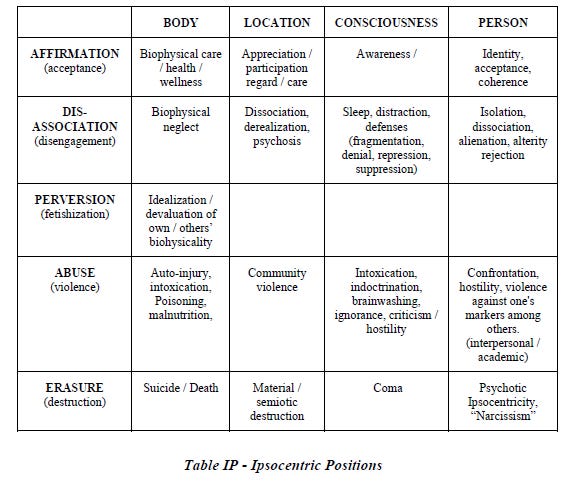
Ipsocentric i-states manifests differently across the four registers of uniqueness (BODY, LOCATION, CONSCIOUSNESS, PERSON) and levels of severity and form several ipsocentric positions in relation to one’s own uniqueness, including (i) affirmation (acceptance); (ii) dis-association (disengagement), (iii) perversion (fetishization); (iv) abuse (violence) and (v) erasure (destruction) (see Table IP below)
______________________________________________________
[1] Abuse or disregard towards one’s own body or the bodies of others are key aspects of personality / interpersonal psychopathology (personality disorders). More fundamentally, abuse (aggression) or disregard (neglect) of one’s own UNIQUENESS or UNIQUENESS of others is the core foundation of all interpersonal / relational psychopathology, including “personality disorders”.
[2] In Buddhism, taṇhā (“desire”) is one of the causes of dukkha (“suffering”)
[3] See other posts