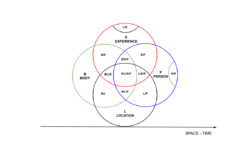
- Uniqueness of (subjective) experienceThe world is the totality of facts, not of things. (L. Wittgenstein) Tractatus notwithstanding, reality (world) is neither things nor facts but rather the totality of events and relations. Event is any change in the physical world. Relation is how events interact. Three types of events are pertinent to the exploration of uniqueness – (i)…
- Uniqueness of the PERSONThe PERSON is how one “exists”, outside of one’s body, in the consciousness of others. It is the totality of markers (names, labels, signifiers, attributes, descriptors, signs) used to refer (point) to, denote and describe a particular individual and her / his life. It is how one is (i) recognized, identified, defined and addressed by…
- Uniqueness of spatiotemporal locationLOCATION is a progression of points in space-time marked by a trajectory of its coordinates. It is a spatiotemporal representation (memory, map, record) of all specific locations of one’s body since its conception to the present moment. Human beings have evolved to experience and construe LOCATION relative to the surface of the Earth where each…
- Uniqueness of the BodySum, ergo cogito. In reversing Descartes’ dictum we acknowledge that, in most respects, it is being (existing) that makes experience (cognition) possible. I am therefore I experience.
- UniquenessUniqueness is a fundamental constitutive attribute of being and being human. Beings and things (objects) “exist” and manifest as such to the extent they are distinct and different in relation to each other. Uniqueness is, essentially, about (the question of) how one “is” as a human being among others.